The Adoption of AI in Finance: From Manual Burden to Intelligent Operations
Artificial Intelligence is no longer a futuristic concept in finance, it is a present-day lever for transformation. Yet, despite the growing hype, many finance leaders are still navigating what AI adoption truly means for their organizations: where to start, what value to expect, and how to implement it effectively.
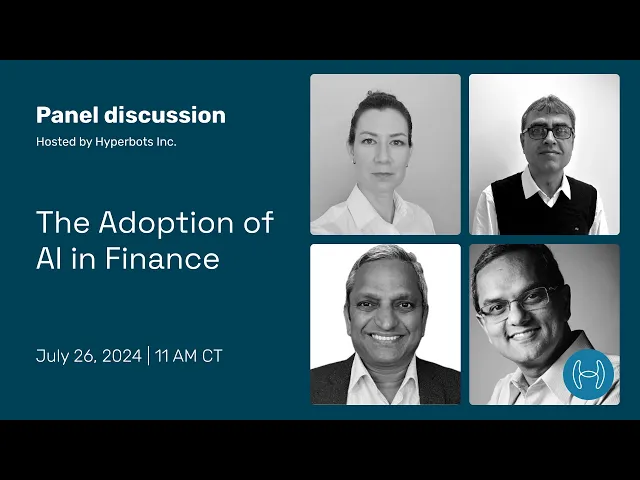
A recent panel discussion on “The Adoption of AI in Finance” brought together finance leaders across industries from construction and manufacturing to retail, energy, and consulting to unpack exactly this. What emerged was not just a theoretical conversation, but a grounded, experience-driven roadmap for how AI is reshaping finance and accounting functions today.
This blog distills the key insights from that discussion, focusing on practical applications, ROI, and the path forward with a lens on how platforms like Hyperbots are enabling this transformation.
Understanding the Finance Function Landscape
To appreciate where AI fits, the panel began by outlining the core finance and accounting functions. Broadly, these fall into seven key areas:
Procure-to-Pay (P2P)
Order-to-Cash (O2C)
Expense Management
Tax & Compliance
Treasury
Financial Planning & Analysis (FP&A)
Mergers & Acquisitions (M&A)
Among these, the first three, P2P, O2C, and Expense Management, stand out as highly manual, transaction-heavy processes. These involve repetitive activities such as invoice matching, expense classification, and reconciliation across systems.
In contrast, functions like FP&A and M&A are more analytical and strategic, requiring human judgment, forecasting, and decision-making.
This distinction is critical because it directly informs where AI delivers the fastest and most measurable value.
Where AI Delivers Immediate Impact
One of the strongest consensus points from the panel was this: AI adoption should begin with high-volume, manual processes.
Why?
Because these areas offer:
Faster automation potential
Immediate efficiency gains
Clear and measurable ROI
For instance, in expense management, AI can:
Capture and process receipt images
Extract relevant data fields
Automatically classify expenses into GL codes
Route approvals intelligently
But the real value goes beyond automation.
AI systems can detect anomalies that humans often miss. For example:
An employee suddenly booking flights from an unusual location
A single outlier expense among otherwise consistent spending patterns
Duplicate submissions or policy violations
These are not just operational improvements, they are controls that strengthen financial governance.
This is where Hyperbots-style systems differentiate themselves: combining automation with intelligence, not just digitization.
The Evolution of AI: Why Now?
AI is not new. As one panelist pointed out, intelligent systems have existed for decades. So why is adoption accelerating now?
Three key advancements have changed the game:
1. Affordable Computing Power
AI models require massive computational resources to train. What was once prohibitively expensive is now accessible, enabling organizations to deploy sophisticated AI solutions at scale.
2. Rise of Large Language Models (LLMs)
Modern AI systems can now understand and process unstructured data such as invoices, contracts, and emails.
This is particularly relevant for finance, where much of the data exists in document form.
Importantly, LLMs are not just generative tools. They also enable:
Intelligent search
Data retrieval
Contextual recommendations
This makes them ideal for finance workflows that rely on interpreting documents.
3. Advanced Recommendation Systems
For tasks like GL coding or transaction classification, recommendation engines can now predict outcomes with high accuracy based on historical data.
This reduces dependency on manual inputs while maintaining precision.
AI in Action: Beyond Automation
A critical insight from the discussion was that AI in finance is not a single technology, it is a combination of multiple capabilities working together:
Intelligent Document Processing (IDP)
Finance-specific AI models
Business rules and logic engines
Workflow automation
Integration with ERP, CRM, and other systems
For example, in a Hyperbots-like architecture:
Documents (invoices, emails) are ingested and understood using AI
Data is extracted and validated
Business rules are applied (taxation, approvals, compliance)
Recommendations are generated (e.g., GL codes)
Transactions are posted into ERP systems
This end-to-end orchestration is what transforms finance operations not just isolated automation tools.
Measuring ROI: The Tangible and Intangible
When it comes to AI adoption, ROI is often the first question and rightly so.
Tangible Benefits
The most immediate financial impact comes from:
Reduction in manual effort
Lower headcount requirements or avoided hiring
Faster processing times
Fewer errors and duplicate payments
In many cases, organizations can achieve payback within the same fiscal year.
For example:
Automating accounts payable reduces invoice processing costs
Streamlining receivables improves cash flow
Eliminating errors reduces financial leakage
Intangible Benefits
However, some of the most powerful benefits are harder to quantify:
1. Fraud Prevention
AI can detect anomalies and suspicious patterns, significantly reducing risk. While difficult to measure upfront, the cost of avoided fraud can be substantial.
2. Employee Experience
Finance professionals often spend a large portion of their time on repetitive tasks.
Automating these tasks leads to:
Higher job satisfaction
Better engagement
More time for strategic work
3. Organizational Agility
With AI handling operational workloads, finance teams can shift focus to analysis, planning, and decision support.
This elevates finance from a back-office function to a strategic partner.
The Adoption Journey: What It Really Takes
A common misconception is that AI implementation is long and complex. The panel offered a more nuanced view.
For a typical mid-sized organization adopting AI in procure-to-pay:
Integration Phase: ~4 weeks
Training & Adoption: ~1 month
Parallel Run (manual + AI): ~1 month
This results in a 3-month structured rollout, balancing speed with risk mitigation.
However, technical implementation is only part of the story.
The Real Challenge: Trust
Finance is inherently risk-averse. Accuracy and control are non-negotiable.
As one panelist emphasized, building trust in AI systems is critical.
This requires:
Human-in-the-loop validation
Gradual transition from manual to automated processes
Transparency in how AI decisions are made
Without trust, even the most advanced systems will face resistance.
Rethinking the Business Case
Another important takeaway was how organizations should position AI initiatives internally.
Instead of framing AI as a cost-cutting tool (“replace 10 people”), successful implementations position it as:
A digital assistant
A way to handle peak workloads
A tool for improving accuracy and speed
This approach reduces resistance and accelerates adoption.
Over time, as efficiency improves, cost savings naturally follow often through:
Avoided hiring during growth
Reduced reliance on temporary resources
Optimized team structures
Integration: The Backbone of AI in Finance
Finance systems do not operate in isolation. They rely on a complex ecosystem of:
ERP systems (SAP, Oracle, Dynamics, etc.)
CRM platforms
HR systems
Email and document management tools
For AI to deliver value, it must integrate seamlessly with this ecosystem.
Modern AI platforms are designed to be:
System-agnostic
API-driven
Compatible with existing enterprise tools
This ensures that organizations do not need to overhaul their tech stack to adopt AI.
Instead, AI becomes a layer that enhances existing systems exactly how Hyperbots operates.
The Road Ahead: From Automation to Intelligence
The panel made it clear that AI adoption in finance is not a one-time initiative, it is a journey.
Phase 1: Automate Manual Processes
Focus on P2P, O2C, and expense management for quick wins.
Phase 2: Enhance Decision-Making
Introduce AI into FP&A, forecasting, and analytics.
Phase 3: Strategic Transformation
Leverage AI for areas like M&A, risk management, and treasury optimization.
As organizations mature, AI shifts from being an efficiency tool to a strategic enabler.
Final Thoughts
The adoption of AI in finance is no longer a question of “if” but “where to start” and “how fast to scale.”
The panel discussion reinforced a few key truths:
Start with high-impact, manual processes
Focus on measurable ROI, but don’t ignore intangible benefits
Build trust through phased implementation
Leverage integrated, end-to-end AI platforms
Most importantly, AI should not be seen as a replacement for finance teams but as an augmentation of their capabilities.
Platforms like Hyperbots exemplify this shift combining automation, intelligence, and integration to transform finance operations from reactive and manual to proactive and strategic.
For finance leaders, the opportunity is clear: embrace AI not just to do things faster, but to do fundamentally better.