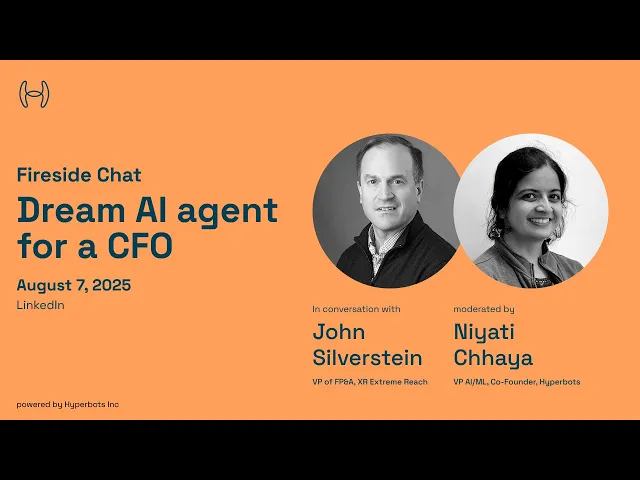
The CFO's Dream AI Agent for Finance with John Silverstein
Introduction
If you are a CFO, VP of Finance, or finance transformation leader trying to understand what AI actually needs to do before it becomes useful in enterprise finance, this conversation is for you.
In this edition of our Fireside Chat Series, "The Dream AI Agent for a CFO," we sat down with John Silverstein, Founder and CEO of Liv Data LLC, a finance transformation consultancy, and a seasoned finance executive with over 20 years of experience leading FP&A, automation, and digital transformation across Fortune 500 companies, private equity portfolio firms, and high-growth startups. John has held CFO and VP Finance roles at organizations including Kinly, XR Extreme Reach, CGS, and GLG, and is a product advisor to Hyperbots on AI strategy for finance. Moderated by Niyati Chhaya, Co-founder and VP of AI/ML at Hyperbots, the conversation covers the daily reality of running finance across 26 entities, multiple currencies, NetSuite in North America, 26 separate SAP instances for the rest of the world, and a monthly financial pack that routinely reaches 60 megabytes before it can even go into a PowerPoint.
John started his career at GE doing automation and has spent two decades trying to make finance faster and more intelligent. What makes his perspective different from most is the specificity. He does not talk about AI in the abstract. He talks about changing dates on 30 files at the start of every close cycle, about a headcount grid that took multiple analyst iterations to get right, and about the moment he realized a highly paid lawyer was being asked to manually pull a contract just so someone in finance could answer a billing question. The dream AI agent he describes is not a vision statement. It is a very specific list of things that should not require a human.
Key Takeaways
The real bottleneck in enterprise finance is not the analysis but the hours spent getting fragmented data into a shape where analysis is even possible.
A 60-megabyte monthly financial pack assembled manually every month is a solved problem waiting for an AI agent to solve it.
CFOs now own pricing strategy, sales intelligence, and product profitability decisions, and they need data infrastructure that matches that expanded mandate.
Data security in finance AI is not a blocker but a design requirement: sensitive financial data must stay in a controlled model, not flow through open systems.
The finance team that learns to work with AI will outpace the one that does not, and that gap is already opening inside organizations right now.
Interview Summary
Meet John Silverstein: Two Decades of Finance Automation, From GE to AI
Niyati: Welcome to the next edition of our CFO chats. We are doing these fireside chats talking about the dream AI agent for the CFO. Today it is my privilege to have John with us. I have been talking to John probably since we started off Hyperbots, so maybe almost like two years now. He is currently VP of FP&A at Extreme Reach, very cool stuff is what the business does. But in addition to that, being a CEO in his past life, worked at different organizations, scaling the finance function as well. Definitely gone through digital transformation at multiple places, so someone who has seen non-automation to automation to AI to yes they are, no AI kind of a thing. Welcome, John, and anything that you would want to get started with?
John: Yeah, thanks for having me. This is kind of dream AI. I think it has been my dream my entire career, trying to do finance automation to make it easier to do this. I started my career at GE doing automation with various tools and things and trying to figure out how we speed things up and get information faster. So it has been over 20 years of trying to do this. And now we finally have the compute power and capabilities to actually make things happen in ways that we could not even dream of a few years ago. So excited to be here. The CFO role, I think, changes too. It is not just the numbers anymore. It is very strategic. You are not just the steward of the financial data. You are trying to go in and be a partner and really run the business, making sure there is no risk, making sure that the business is on track and that it is going in the right direction at all times and that any issues that are popping, you are able to solve those. So excited to be here again and to really put this together. Like you said, we have been talking for two years on this topic and we are really seeing it happen now.
How the Daily Reality of a CFO Differs Between a Startup and a 100-Year-Old Enterprise
Niyati: Yeah, absolutely. Thanks for that. So on the topic of what a CFO does every day or what a finance leader does every day, what do your daily tasks actually look like? What do you do? Just call the people, ask for numbers or something else?
John: Yeah, every day can be different and it depends on the organizations I have been at on what the focuses are. If you are in a high growth startup, your day might be a little bit different. Making sure that you are on time and you have the funding to just pay the bills until you get the first dollar in the door versus the longstanding businesses that I was at early in my career where they have been around for over 100 years. That area of trying to make sure that the business continues to be more and more profitable and that you are able to get the projects in line, it is critical that you are able to do that. That requires a little bit different approach on a daily basis than maybe when you are starting a business.
Looking at your cash flow every day, looking at your dashboards if you hopefully have them already, sometimes you have to start creating or look for the data directly in the ERPs. Again it depends on the maturity of your business. But every day I come into the office, start my day wherever it is, and make sure that everything is on track from metrics, revenue, projects that are going on in the organization, that they are happening and that they are on time, or if there are any issues that we have the right meeting set up for the day to make sure that we are solving those issues.
Managing a CFO Dashboard Across 26 Entities, Multiple Currencies, and Fragmented ERP Systems
Niyati: Got it. So let us just take an example of a current organization, right? Multi-country, multi-currency, a lot of P2P movement, a lot of vendor movement, all of that. And in that case, what does your dashboard actually look like, yours or the CFO's dashboard? Do you just look at everything from a bird's eye view, or are you the one who goes in and stares at the numbers more closely, compares contracts with them?
John: Yeah, with my role, I have to go a little bit deeper than just as a CFO in some of the areas to really answer the questions. But it is often starting the day by answering questions from the business or from the leadership or board or our owners, and understanding where volumes are at specifically. We are a volume-based business, so that is critical. And then it is locations of those volumes and things.
We are multi-currency across over 26 entities. So to get all that data and make sure it is accurate and reporting up into the systems, some things trigger and go to our data warehouse, but it happens. We have to wait until it gets to the data warehouse. So sometimes we have to run certain things on our legacy systems once a day or things like that. But it is critical that we get on top of that, and we try to get more regular visibility. Sometimes you have to go a little bit deeper to understand: oh, we missed the day, or something happened, or a report did not run.
Liquidity is a big part of my responsibility too. So understanding the liquidity forecasts and how we go through and any changes that we need to make on a daily basis based on what we are seeing. We have a payments business, so volume of payments is obviously very critical for us to make sure that we are funding appropriately through either our balance sheet or other needs.
Why Live Financial Data Is Still Out of Reach When You Have 26 SAP Instances and One NetSuite
Niyati: And you already talked about data and legacy systems, but what is the other top pain point when it comes to reviewing financial metrics and reports?
John: Our biggest pain point is really getting the data. The financials in our ERP, you can often only look at them once a month, and three weeks after the month closes before they are really right. So that is the biggest pain point: looking at all the systems during the current month to actually see where you are landing to make decisions and understand things. It is really that data integrity, making sure that it all rolls up properly and that you understand where to get all this information.
Some things we can look at in North America pretty easily. It is in our NetSuite system. But if you want to look at the rest of the world, that is in 26 different SAP instances. So it depends on what you are looking for and the details and what you are actually seeing in the metrics if you have to go deeper. So the pain point is that you do not have that live view really of the business today because of how broad we are and the many instances of different systems.
We have our own platform. We are in the advertising space. So for us, our own platform is where the volume sits. And then some of that volume goes into NetSuite daily, some of it goes in monthly. Some of it is on subscription. So it is organized to make sure all that stuff is coded properly, and that there are automations built so it does not require hundreds of people to go in and actually put the right information together for us so we can eventually close the books and see what actually happened.
Why Even a Large Finance Team Cannot Keep Up With Stakeholder Data Demands Across a Global Organization
Niyati: So do you end up downloading multiple reports from different places and feeding them into a single system? Or is it more that there are a bunch of people who do that?
John: There are multiple people that do it, and there are different purposes depending on what we are looking at and whether it is going to investors, someone within the business, or the sales organization. So in that case, it is different types of data. We use some tools to pull data from all these systems that pulls it together. So that is how we kind of tackle it today: through lots of different queries and data pulls to really get the information that we need.
Niyati: And you mentioned stakeholders. Everyone looks at different data, or the same data differently based on the KPI or the stakeholder they are sharing it with.
John: Even the same KPI, honestly, between different stakeholders. Some people are very graphical and some people want it in a grid. It varies on how they consume information. So that is the other challenge, particularly in an FP&A type role, making sure that the stakeholders have what they need in the way that they consume it.
Hundreds of Spreadsheets a Week, a 60-Megabyte Monthly Pack, and a PowerPoint Nobody Should Have to Build
Niyati: So who actually makes the slides or the Excel sheets?
John: The Excel sheets and spreadsheets, we are starting to use some AI tools sometimes. But it is generally a manual process of putting together a PowerPoint. There are PowerPoints for putting together almost on a daily basis. And then Excel spreadsheets when you are looking at deeper views of things or analysis. We are putting together probably hundreds of spreadsheets on a weekly basis that go across different regions and each business unit and each product. And then how profitable is that, who actually works on it, and then you get into the people pieces and the initiatives behind there. Are they executing or not executing? And then are there changes that we might need to make because of where the data is actually landing, where the revenue is landing, or whether our costs might be behind or ahead based on our initiatives from a people standpoint.
Niyati: And how do you review them? Do you leave comments on those sheets or is it all via email or in meetings? What does that process look like?
John: Most of our stuff ends up getting sent out through emails unless it is too big, then it is going through different drives depending on who it has to go to. Reviewing is a challenge today because there are different ways of looking at it. We are multi-currency and looking at different regions. Do you want to look at it in a budget currency, constant currency? It depends who it is going to. So that becomes a challenge to make sure that everything is right because you have different numbers. And to track all these different spreadsheets, if two spreadsheets are going and they do not match, it is a challenge today. It is a manual process to really check all these today, and you cannot possibly check every number on every spreadsheet.
How Global Compliance Across 26 Tax Jurisdictions Adds Another Layer of Manual Finance Work
Niyati: And how complex is compliance in all of this? There are numbers that need to match, there are always external agencies, definitely geo-specific requirements. So 26 entities, potentially 26 different agencies. How do internal controls, compliance, and taxes and audits play a role from your perspective?
John: They become stakeholders too from a compliance and tax standpoint. Just earlier I had to give by-country information for specific requests. So it varies and it is complex to do because of the different structures, particularly on the tax side and restructuring and things that you can do. The compliance and making sure that you have the right oversight and that we have the right teams, for us it is handled generally through people today. And then we have our typical controls and things on approval processes and going through our contracts and all that stuff on a regular basis.
How CFOs Now Drive Pricing Strategy, Sales Intelligence, and Product Profitability Decisions
Niyati: And do you actually get involved in business model discussions with the CEO, especially pricing, target market, all of that, because you have all the data?
John: Yes, we do that. That is a big part of what we are creating all the time: how do you put the slice and dice, or what is the business case if you are moving a business around, or you want to look at a business differently, or what is the profitability? What are the direct costs versus the indirect costs? What is shared between all the businesses? What are the corporate costs? There is a lot of those discussions. And understanding how we can improve some of these products, or maybe how some of these products operate together.
So there is a lot of discussion on strategy for that. And then it gets specific on the customer level on how we go to market and then how we actually price it. Do we price it as a subscription with some transactional, with some caps and minimums to ensure that we are making an appropriate amount, but it is also a win-win situation for both the customer and us. So that gets into the financial aspects of how you want to arrange a pricing negotiation with our customers.
Niyati: And do you actually go all the way into the sales and marketing function or not really?
John: Yeah, for us it is definitely a lot on the sales side. They are always trying to figure out or understand not just your new pipeline. For us, we have been around a long time and almost every brand is our customer. So then it is: how do you upsell or get them to use other pieces of your product, the complementary products? So for us it gets into that analysis of what they are using and not using.
You rely on product analytics and usage data, essentially, to even inform back on the credentials. And how they used it and what they have done in the past. You want the salespeople to have as much information as possible when they are speaking with their clients. There are also issues that happen with clients that you want to make sure that you are able to either resolve or work with the client, because it can be on either side that is causing various issues within the finance organization from billing to collecting the cash and all that.
Why Financial Documents Are Scattered Across Drives, Emails, and VPN Servers, and What That Costs
Niyati: Maybe any specific kind of documents that you look at daily. Where do you store them right now?
John: A lot of our stuff is in various drives. So we have to go to either your legacy like a drive that is on-prem somewhere that you have to VPN into, you still have some of those things, and then it is more of your Microsoft OneDrives or Google Drives and things like that, and Box, and there are places like that. So it is stored in various places. And then sometimes it is just in emails, and then it becomes a challenge on how you actually search and find the details and information you need. Or it is being requested because often someone is asking about something in the past and you have to go back to how it was done or where the details actually reside.
Niyati: Do you generate insights from these documents? Or is it all the data team's job?
John: We do, because it could be that we see something in the data that does not make sense, or there is an anomaly, or we do not think something should be allowed to happen or something contractually. Then it is like you actually have to get an insight and go to an actual contract and go to the legal team and ask them to pull the contract manually. Some of that information obviously could be a lot more readily available to everybody, or who needs to have access at least, so that they are able to ask the question and get the information without having to have a highly paid lawyer go in and look at a document.
Hyperbots, Copilot, and Claude: How John's Finance Team Is Using AI Tools Today
Niyati: What AI tools do you use right now?
John: We are utilizing Hyperbots as one of them. We are in the early phases of that. We are also using Copilot, which is enabled for us. We are using Claude a little bit for code writing and things too. So those are the three main ones. From a development standpoint, in our development teams they are using others as well. But in finance, we are using mostly those.
The Dream AI Agent for a CFO: Connect to Every Database, Kill the Monthly Pack, and Never Build a PowerPoint Again
Niyati: And what does your dream agent actually look like? Because you have talked about data being a huge pain point, then everything being everywhere and not getting everything ready. We talked about spreadsheets and all of that. Then you also talked about representing the same data in different ways for stakeholders. So does your dream AI agent solve this problem or something else? What does your dream AI agent actually look like?
John: Yeah, my dream AI agent would do a lot of the legwork for some of the stuff that I typically go to an analyst to try to put something together or do some analysis or change with some guidance. And then you end up in iterations with an analyst. My dream AI agent would do that. But then the presentation of data has always been a challenge in finance because of those different ways that you need to present it. Getting it from an Excel spreadsheet that is in a table with lots of data into a summarized version that is just a KPI and how is it doing and is it good, bad, or do we not even know. The AI agents, what I am finding, is that you still need to structure the data a little bit and get access or give it access to the right data, which is still a challenge today because of the amount of infrastructure that you would have to deploy it.
And it also gets more challenging from an AI perspective if you give it too much information at once. So that is our challenge. But the dream AI agent would be able to go through all that information and connect directly to our databases and give us information or anomalies in our data that we may not even have time to analyze or go figure out. And then the daily stuff, the things that we are doing just to pull things together every month to get together a whole financial pack in a 60 megabyte Excel document, plus then you need to put it in the PowerPoint and make sure that it all ties out and everything.
That to me is the same every month for the most part, except the dates change. Maybe there are a couple of different ways you want to look at it depending on whether it is beginning of the quarter or middle of the quarter and you want quarter-to-date information. But if you could tell an agent what you want and they can come back and give you the PowerPoint, that is the dream. Because we waste so much time just putting together information in a way that is consumable for these different stakeholders, and making sure it is telling the right story. Or maybe our story is that we pulled the data wrong and we are actually telling the wrong story in the end too. Someone has to review it. And sometimes this stuff is caught all the way at the investor level or something. They ask the right question and it is like, oh, we missed something. So if we could get past that and get ahead of it a lot better and quicker, not having to wait and spend the cycles of just creating all these documents and reviewing and reviewing and reviewing to make sure everything ties, it would be huge. Again, it is all derived from the same data sources. We consolidate into one ERP, have all the data there, and it should tie to that information. But then there are different cuts and slices of that data, and those cuts and slices need to tie to the totality.
Why Finance Teams Look at Data They Do Not Need and Miss the Data They Actually Do
Niyati: You said there is a lot of data you do not even have time to get to. How often is some of it not necessary? In the sense that if there is a bunch of data or insight that you do not have time to get to anyway, you are not getting to it. So is there even a need to look at it? Or is it good to have?
John: I think the real question is what are you going to do with all this? People used to talk about analysis paralysis. You just overdo it. The problem is that you end up analyzing and going down the wrong paths sometimes. The questions it raises are: do you need this information, what would you do with it, are you going to change the way you operate the business, and can it change it? That is the key. Could you often, if something is down, know why it was down? Why was a customer spending less or doing less advertising or buying less of something? And if you were able to get some information that you would have had to go and analyze their financial statements or records and news and all that stuff, it is just not enough time.
But if you have that information, it can be extremely valuable. Maybe you should renegotiate a contract with the customer or a vendor. Or maybe based on what you see or hear or a trend, maybe you should double down and maybe you should go into a deeper partnership with somebody, and it can really add value to the customer. And I do not think we are able to get there. When you have thousands of customers, it is hard to see when something is happening in not your top ones. You cannot look at every single one. So there is information that can be elevated that you may not have the KPI on, and you do not have enough resources or analysts to look at it. So I think it is valuable, but you need AI at the same time to go through it and parse through it and make sure that you are not getting too much information.
And then it could learn. You could say, I do not need this anymore, it did not help me. Today you are telling your analysts that and they are going to pull the same thing next month. They just know what they have done in the past. They do not know the new stuff or the new trend that is inside your data until someone asks the right question.
What Security Guardrails a CFO Needs Before Trusting AI With Sensitive Financial Data
Niyati: Let us say what happens to security, what happens to privacy? Your AI is listening into everything. Are you worried about it? What are the guardrails you would need for you to be comfortable?
John: That is a good question because privacy is obviously critical and you do not want all your information out there on your company or otherwise. It is critical that you do have the right guardrails around it. You also have to be careful on what if AI is actually making a decision and can actually do something or post to your ledger or send out a report to the CEO or your board.
It is critical that you put the guardrails and that there are proper approvals and reviews around it. Security has got to be top of mind too. I can see, when we are going to all these tools that are out there, what is actually being trained, and there have been many issues today even with that. You hear about it all the time where something was available in ChatGPT that got out with somebody's post. So it is critical and you have to be cognizant of it. My view is that it is going to get better, but you need to put those guardrails behind which data you put where, if it can be used and things like that. And just make sure that if it is truly confidential, sensitive information, it is behind your own model, in your own system.
The Finance Tasks John Faces Every Day That Should Already Be Automated
Niyati: Maybe how often in the last few weeks have you come across some task where either when you looked at the task, or after you had spent hours on it, you felt like it should have been done by an AI assistant or an AI-based workspace? And what was this task? Can you share some experiences there?
John: Yeah, I have those tasks every day. It is every hour. I have done some this morning where just getting everything ready for our July close and changing the date on all the files. Stuff like that. I do not know why I have to ask an analyst or I have to do it or somebody. Things like that just do not make sense. Or putting together a new analysis on headcount or something that I have done a number of different iterations of over the last several months. Oh, how do we look at it trending for the last five years? I do not think I should have had to do that. Or maybe I want it in a specific format. If I come up with the format, I would really like AI to fill in the details. Like, if I want a grid that has departments on one side and years on the top and does some calculations, but then it has to pull data based on criteria. Today we are writing Excel formulas to do it.
I could use Copilot to tell me which formula to use, but it does not actually put the formulas in necessarily. And often it is faster for me to type in formulas because I have been doing this in finance for quite a while. But I do not know why AI cannot do it and get it right right away on a lot of these quick analysis or quick formations. It is starting to get there when you put data in an organized fashion and ask for very specific things. It is Claude or the different tools out there. But it sometimes gives you incorrect information and you do not even know, or it does not recognize that you are halfway through the year so you do not have a full year of 2025. You prompted it wrong and you got the wrong result, and you have to keep prompting and prompting and prompting to get it right, when you could have just typed the formula in yourself.
At any time I do a PowerPoint, I do not think I should have to do a PowerPoint anymore. I used to say you graduate from Excel and eventually you do PowerPoint in your career. I think now you should not be making it. You might be looking at the actual data, but you should be presented to by AI from a presentation-type visual. And then you should comment on it and it can come back with an iteration, which is how you work with your analysts today anyway. So I think we should have a little bit of both, reviews and things. That is my dream with AI, coming and doing a lot of this stuff. I ask the question and it comes back with an analysis just like you do with an analyst.
From Data Gatherer to Decision Maker: What AI Unlocks for the CFO and the Whole Finance Team
Niyati: All right. I think on that note, you pretty much laid down a doable but still very ambitious task for your agent. So I am hoping you build it quickly. But any final thoughts?
John: Yeah. My dream is that the tasks get automated on that. What we really need to do is value it. It comes down to value and which data and information you look at. My thought is that we need to free up CFOs, their staff, and everybody to look at the intelligence that is coming out of AI versus having to come up with it on their own all the time. If they are asking the questions, you would go to an analyst anyway to pull together data and give you the information. But if you could have AI do that stuff, it would really offload a lot of the work. Just us reviewing data and information presented in different ways through PowerPoint, Excel, or these different places, and then we could just interact in a different way. We could probably get more value even out of our staff too. They would be armed with information that they may not have come up with themselves. They may even get trained faster and things like that, as well. There is a lot of things I think can happen. They may not need to learn the way they used to. So I think we are making huge progress and I am excited about what is happening in the marketplace right now.
Niyati: All right. Thank you. I think with that we should close the session. Looking forward to more discussions. But thanks for all of that. I love listening to you talk about what your imagined AI looks like. It is a very clear goal for me as a tech builder to get you that kind of AI soon.
John: Yeah. Look forward to it. Bye.
How Hyperbots Is Helping CFOs Like John Today
Everything John described in this conversation maps directly onto the workflows Hyperbots is built to automate. The 60-megabyte monthly financial pack that needs to tie out across 26 entities. The Excel formulas written manually for headcount grids. The invoice data that sits in NetSuite for North America and 26 SAP instances for the rest of the world, waiting to be reconciled. The anomalies nobody has time to find. The contract that requires a lawyer to pull manually before anyone in finance can answer a simple billing question.
Hyperbots' Invoice Processing Co-Pilot delivers 99.8% extraction accuracy and 80% straight-through processing, removing the manual coding, matching, and posting that currently requires people across John's global finance team. The Procurement Co-Pilot compresses the PR-to-PO cycle to under five minutes, with an 80% reduction in creation and dispatch time, addressing the P2P friction John described as a constant source of volume-management pressure. The Payment Co-Pilot automates payment scheduling, approval routing, and ERP posting, directly relevant for a payments-volume business like XR Extreme Reach where liquidity management is a daily priority. For the month-end close cycle that John's team is constantly racing against, the Accruals Co-Pilot automates the discovery, booking, and reversal of accruals with less than 5% variance between accrued and actual costs.
The anomaly detection and fraud prevention layer John asked for, something that continuously watches the data and flags what matters rather than waiting for someone to ask the right question, is built into how Hyperbots' agents operate. And for finance teams managing multi-agent workflows across complex, multi-entity environments like XR Extreme Reach, Hyperbots is architected to coordinate specialized agents across extraction, matching, approval, and posting without requiring a single source-system overhaul.
John's dream is clear: stop spending time making the data presentable, and start spending time on what the data is actually saying. That is exactly the shift Hyperbots is built to enable.
See it in action with a demo or start your free trial today.