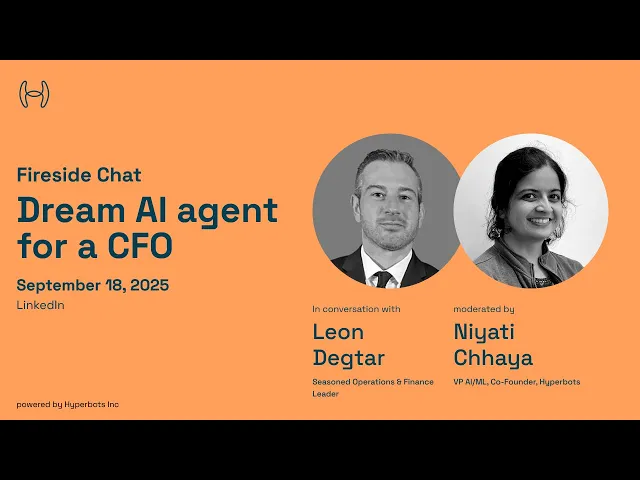
The CFO's Dream AI Agent for Finance with Leon Degtar
Introduction
If you are a CFO, finance operations leader, or anyone managing finance across multiple clients or business units, this conversation will resonate directly.
In the ninth edition of our Fireside Chat Series, "The Dream AI Agent for a CFO," we sat down with Leon Degtar, a seasoned operations and finance leader with over 15 years of experience guiding startups, growth-focused organizations, and professional service firms. Leon has driven results including 80% revenue growth, 600% portfolio expansion, and 70% recruiting cost reduction across his career. He currently works as a fractional CFO, building and deploying finance teams across a range of clients simultaneously. Moderated by Niyati Chhaya, Co-founder and VP of AI/ML at Hyperbots, the session brought a perspective that is less common in this series: not a single-company CFO, but someone managing multiple organizations at once, each with different data systems, different priorities, and different stages of maturity.
What made this conversation stand out was Leon's ground-level honesty. He is already using AI across his work. He knows exactly where it helps and where it falls short. And his vision for a dream AI agent is not abstract. It is built from the daily reality of spinning multiple plates across clients, teams, and systems, and knowing exactly what would make that easier.
Key Takeaways
- The biggest finance bottleneck is not lack of data, but the manual effort required to unify fragmented systems, formats, and workflows.
- CFOs create the most value when they challenge business assumptions through scenario analysis, margin validation, and data-backed forecasting.
- Leon views marketing and sales as financial investments that should be measured at a granular ROI level, not approved with broad annual budgets.
- AI becomes powerful when it proactively aggregates insights across clients, systems, projects, and teams instead of waiting for the CFO to ask questions.
- Finance teams still spend enormous time cleaning, transforming, and restructuring messy data before any real analysis can even begin.
- Security is the biggest barrier to AI adoption in finance because intelligent agents handling sensitive financial data create governance and access risks.
Interview Summary
Meet Leon Degtar
Niyati: Leon is super great at growing finance teams, operations, bringing in people, scaling, doing all of those things. And he is going to bring in that experience in essentially helping us understand what a dream AI agent looks like when looked from his lens. Welcome, Leon. Anything you want to start off with?
Leon: Yeah, no, thank you for having me. I am excited to get into the conversation. I know the landscape is changing rapidly within tools that are available, automations and AI implementations and various solutions. So excited to get into it.
What Does a CFO Actually Do Every Day?
Niyati: Let us just get started with the basics. What are your daily tasks as a CFO? What do you do every day?
Leon: Every day, I think this is the same, right? There are different grades of CFO and different grades of businesses. I support a variety of clients and that really changes day to day. But my approach is generally to be structured as much as I can. Early in the morning, it is usually just email catch-up, which is very common. Review team status, kind of a morning triage and some project management of my teams that are deployed across clients. And then beyond that it really depends on what I have laid out in the day. If it is client work then it is really reviewing reports or outputs that have come my way and providing recommendations back, building decks, or just having communications and meetings with whoever I need to, whether that is vendors, banking, or clients. So day-to-day tasks really change. It is pretty variable, which I like in the work.
What Metrics and Reports Are CFOs Always Watching?
Niyati: Are there kind of metrics that you review every day or reports that you regularly review? Something that you are always on the watch out for?
Leon: Yeah, and I think that varies, right? You set priorities because some of my clients are engaging in large capital expenditure projects that have different metrics. I do my best to implement data-driven approaches for everybody, build dashboards or have data streams and data flows that allow for aggregation of real-time data. So as much as I can, there is real-time data available.
Some of those have implemented cash flow monitoring systems. It could be budgetary review, ongoing budget reviews for CapEx projects or others. But it is prioritized based on the business I am working with, its industry and its life cycle. Obviously, businesses that are growing and considering CapEx or investment deployment or potentially seeking investment or exit strategies are going to have different daily review requirements around margins and pricing as far as new work that comes in. Others might have cash flow circumstances where there are constrictions and that needs more tight cash flow monitoring. So it is really dependent on where the priorities are. There are always weekly, quarterly, and monthly cadences depending on what is available and more so how much time is available to build out and identify those metrics and KPIs, where the timing could be that it is just too labor-intensive to get real-time inputs.
Why CFOs Struggle to Unify Financial Data Across Multiple Systems
Niyati: So the biggest pain point is that it is labor-intensive in putting everything together?
Leon: You know, the pain points are ones that we are going to see throughout. It is, if it is labor-intensive, there is probably a technology restriction that creates it as such. The concern about AI is really the data availability, data normalization issue, integrations, and really orchestration. To be able to get that real-time view, it is the full stream of the data flow when it comes into what systems that needs to be aggregated through to finally populate to an end database to be able to provide you those metrics and real-time inputs if you can.
So if unavailable and you are stuck in whatever industry you are in and you have to play in variable systems, sometimes you are beholden to a larger vendor or a larger client and are not able to normalize that data. It has to come in either manually or through CSV or various uploads. So the challenge becomes there depending on volume, timing, and origin of really that data source and the data flow. If it is timing, it is just obviously still a challenge to unify business data across systems.
How CFOs Balance Delegation, Data Oversight, and Financial Operations
Niyati: How much of this do you end up doing on your own? At what size of client do you actually end up crunching all the data in, trying to unify, trying to find anomalies? Or is it typically delegated?
Leon: It is delegated. What I am doing is essentially building the teams that are able to take on the workflows that are needed, but at the same time trying to identify areas of automation, data normalization, or ETL processes, whether that is integration middleware layers, Zapier connections, and things like that. But oftentimes there is a tech stack issue that I run into with clients and I try to identify and optimize that tech stack because systems are not integrated well. They build processes that are not mapped from parameters or data points across systems to easily extract and transform that data to unify it.
So some of it is internal, to build out better systems, process tech stacks, and data infrastructure. And some of it is really, like I said, you are beholden to external sources. And sometimes that data is just behind a wall that you have to work around due to key suppliers, key clients, et cetera. In those cases it might be a hybrid. Day in, day out, we are finding more and more opportunities to automate that either through agents or integrations or API connections to do that with less manual input. I think that is going to take some time, but we are seeing big improvements there. And then the challenge is going to be making the right selections because there are still a lot of choices as far as how you can approach those problems on a case by case basis.
Who Are the Final Decision Makers, and How Does Data Flow to Them?
Niyati: In this setup, who is the final decision maker? Who takes the decision?
Leon: The outcomes really become cross-functional. The outcome for process improvement downstream at the production level of people doing the accounting, doing month close or FP&A gathering insights, when they get to get out of the ETL process or out of data extraction and loading, they can do more strategic, insightful work and the timing becomes faster. So you find an efficiency in the productivity enhancement at that team and then the ability to deliver real-time inputs to a leadership team, be it CFO, COO, it could be marketing, et cetera.
If you are able to provide key dashboards to decision makers and give them insights, KPIs, metrics, OKR outputs, that should be a cross-functional solution. Because if you identify those and then identify, hey, there is a delay, a lag, maybe there is a lack of insight or inputs from the overall architecture of the data that we are not even seeing certain unit economics that may be available to us, you identify those, optimize the workflow, and the production-level accountants and FP&A people expedite their outputs and provide better quality. And the timing and ability to make decisions, strategic inputs, and pivots is greatly enhanced because you are not waiting for a closed cycle.
How Do Business Model Discussions and Scenario Analysis Work?
Niyati: How often do you get involved in business model discussions? Things like input to the CEO or creating something for the board?
Leon: Providing board-level and business model inputs is a big part of the role. Every business model has some variables and parameters and levers to provide potential different what-if and scenario analysis. And before you even have that model and data to validate what your assumptions are, the business model is about identifying what you believe: your margins are X, your price points are here, and this will result in some kind of financial output if you tie that to a quantitative analysis.
Especially in smaller and growing businesses that do not have this level of input and insight, they are working off of maybe history from legacy information, from "this is how we have always done it." And given the current socioeconomic and various economic cycles, those assumptions have changed greatly, whether it is inflation rates or tariffs impacting the industry. So you need an ability to test those assumptions on that business model and build a model for forecasting.
A lot of that I drill into. I meet with the leadership team or the stakeholders and go deeper to identify what are the key quantitative assumptions they are making about their business model that really input: is it your acquisition cost, do you have that insight, do you have your price points or margins if you are making an investment or a growth strategy? For me it is always tethered to some level of data analysis. And I think it is more so you expose the reality when you have the ability to report back on it and deliver that insight in a way that triggers a little bit of that creative function of leadership to say, okay, we have been looking at it one way, and I can show it to you through the lens you have been seeing it, but here is the reality of the situation for a comparison. Allow them to determine, are your assumptions valid or have we just broken them and do we have to go back to the drawing board?
How Does Finance Intersect With Sales and Marketing?
Niyati: Where does sales and marketing come into play? Do you end up interacting with them, influencing them on GTM strategies?
Leon: I think it is really important. Marketing has become incredibly data-driven, as has sales. There are a lot of success metrics and criteria you can put downstream, lower in the sales funnel, to identify whether the strategies you are utilizing are successful. Are you running A/B tests? What is the impact on cost of customer acquisition? What are conversion rates as applied to varying strategies?
Marketing is an investment and marketing has an assumption of a rate of return on particular strategies. We have so much access to varying mediums for outreach, for investment, for boots on the ground at trade shows and conferences. And those are all dollars at play that you are making assumptions about, whether you are spending and deploying them in the right areas. I do not like taking an aggregated approach to these things because I think there are always areas of optimization lower. If you have a generally good return rate in the aggregate, just revisiting it and rubber-stamping it for the following year is a lazier approach than drilling in.
GTM is probably the area of business back-office operations that has seen the largest advancement in automation and AI. The challenge is just making good choices because it is a very saturated area of new technology. But it is a particular area that I think is very key and is often lost on some CFOs because it is a little bit outside of the wheelhouse of traditional finance. I absolutely like to dig a little bit deeper into that data and analysis, and it should be available if set up with the intention to do so upfront.
What Documents Do CFOs Look at Every Day, and Where Are They Stored?
Niyati: What documents do you actually look at every day? Where do you store them?
Leon: It depends on the client. Sometimes it is still a traditional cloud repository like Google Drive. We use an application called Keeper that does a lot of retention and, in particular for accounting and the close, does great document retention and systemization of accounting reporting and month-close protocols.
The only thing I am guaranteed to look at every day is my email and my calendar. Beyond that, it really depends. I set kind of weekly targets and do particular reviews with different clients. I definitely look at cash positions often. It could be a report that gets sent back to me with some key balance sheet items week over week that I want to look at: working capital changes, variance analysis and trends, aging reports, or cash. If there is a cash-constrained company, I could be looking at a budget-to-actual. It is really dependent on the needs of each client.
I set the expectation of reporting that I require back from my teams, and where available, I set up good dashboards. Some clients have brought in Float as a cash flow monitoring system. I might also be looking into just lower-level reporting with some of the employees that I put into place at these companies.
Every day I am also looking at where my team is deployed and what they are working on, because for me it is a very structured approach to everything. I have timelines and milestones set across each client and I am generally looking to make sure that is getting done. They can flag certain anomalies for me. When a particular month close is done, then I will be looking into the reporting output at a deep-dive level where I spend the most of my time. In the interim, it is check-ins along the way with my team doing active monitoring. If we see something that flags and it warrants outreach, then I am that escalation point back to my clients' leadership or CEO, to identify: hey, you have got a trigger here, a potential constriction, or we have to make some changes.
What AI Tools Are CFOs Using Today, and for What?
Niyati: What AI tools do you use right now, and for what tasks?
Leon: I use a variety. ChatGPT is my core for a lot of things. We use the Teams version, which closes off the open data. I still use it for some data analysis and it is getting far better. Copilot can be okay as well. For report building and sometimes just client status reports, we use a tool called Gamma that does good outputs of clean PowerPoints and presentations. QuickBooks has some AI implemented. We also have business modeling systems like Fathom that has some AI integration. And obviously Hyperbots with clients that require large-volume invoice intake.
AI is becoming ubiquitous and becoming kind of standard in every tool and system. They are building some level of LLM or machine learning into the back end of most modern technology systems. So to say, yes, there are some key tools that I turn to for assistance in particular areas, but I am finding more and more that it is just becoming an active portion of and ingrained tooling to most software.
Where CFOs Need AI Most for Financial Data Extraction and Automation
Niyati: In the last few weeks, have you come across a situation or a task where you were like: this has to be automated?
Leon: A thousand percent. If there is a large amount of documents, like say some PDF documents that you need to extract, say there is a variety of bills and you just need to extract inline, unit-itemization-level data, aggregate it in a spreadsheet, do some kind of analysis, instead of that manual data entry, that is done. You can feed that through most modern AIs and pull that together. A lot of bits of data aggregation, if I am getting data from disparate sources and maybe it is not all Excel-based, to transform that data into something that is structured and can be analyzed, that is a good use case for AI, and I have used it in that way.
That said, you still have to check accuracy. I still do not trust it all the time. It can still hallucinate. It has gotten highly accurate, but those are some of the things where I know, hey, this is safe enough. In what we do, 99.9 percent is not good enough in a lot of cases. This is accounting. It is tight reconciliation. Depending on the use case, if that demand is a little looser or the data volume is such that I can do some level of secondary check, I still have to do a secondary check.
What Does an Ideal AI-Powered Workspace for CFOs Look Like?
Niyati: Let us say you woke up in the morning and had an AI-powered workspace that had all the features you needed. What are those features and functionalities?
Leon: I think a lot of people would say you just want another version of yourself. To create that would require access across all of the sources of data, right, and that becomes a data privacy concern. But it is really a sounding board that has all of the source access that I have, something that can be combing through my variety of projects or communicating with my team to aggregate information, whereas I still require to do check-ins.
What can go and come, and we are getting closer and closer to it: you know, who can kind of go and do things while I am sleeping and come back and wake up in the morning and say, where are we at? Where did the day end? I am generally spinning a lot of plates: communicating with clients, doing sales, managing my team, doing some level of escalation support.
Even if I truncated that into various agent buckets, it is really having my own personal leadership team that is very aware of what is going on in sales and marketing, on operations, on process improvement, and even continuing education. The landscape is changing and tools are rapidly evolving. New solutions come to market every single day. So at the same time, I also want to be paying attention and keeping my ear to the ground. Am I making the top recommendations to my clients from a technology stack standpoint? What is new, what is changing? That is another feeder I need. But yeah, it is really the morning dashboards and somebody that would know what I would be looking for and just bounce those things off, with contextual awareness across all of the areas of focus I have to spend my time in day to day.
What Would AI Inside Email Look Like for a CFO?
Niyati: What do you think a CFO would like to see if an intelligent agent also sat inside email?
Leon: It is one of those things where I get almost a little bit more philosophical with it. At one point, do we take the human element out of everything? There is still a level where I like to keep my email a little bit human. It is where I kind of do not always want to put agents. There are some level automations and rule settings that you can always do, but you know, there is always the easier side of like, hey, this needs to go to scheduling and it gets passed to my VA or it is a quick question with a quick answer.
What would be cool is if it understands intent and priority, so I do not have to go and check, and certain things pop up notified as high priority. The agent can respond almost on your behalf. I think there are different ways to approach it to keep the human element in so that it is not always just AI triaging communications with other people. But I think it would flag really intense signals and prioritization, which really needs to know my prioritization. How do you know what is important to me and how I would generally like to respond? And maybe reach out for input: hey, I think this is high priority, what would you like to do or respond? And then there is still a touch there that might increase speed of response.
What is email? The biggest complaint is people who are slow to respond or cannot keep up with it. With inboxes that blow up every 15 minutes, it becomes the management of that to allow for a more rapid response. But I would still always prefer that response to still feel like me. Otherwise I feel pretty disconnected from my audience.
How CFOs Want AI to Make Excel and Financial Analysis Smarter
Niyati: How do we make Excel even more intelligent? What is the dream when it comes to Excel and accounting data analysis?
Leon: It is a transformation of data structures. Power Query has become an incredibly powerful tool within Excel to normalize, transform, and load data. But it still has a learning curve. It is very, very powerful, but it still has a learning curve.
When you see the output of Excel formats and QuickBooks is particularly one of the more annoying ones that kind of formats financial reports and does not always provide well-structured and clean data types, it has direct integrations into Power Query and Excel and all those other things. But the ability to transform, intuitively transform, data that is coming from a variety of formats where there is not always the exact match of lookups or mappings, I think there is a lot of low-hanging fruit where agents can start resolving that issue.
The biggest challenge to financial analysis is often the data structures. We are finding more and more strong tools, even in Excel, that transform and load into structures and ways that we can automate outputs of reports. But they still require input and they still need to be checked. If something changes in a format somewhat in some period for a reason we do not know, there can be a failure of an automation downstream. So those are some of the things where I think we are going to start seeing more and more where the AI agent intuitively looks through varying formats, identifies structures, and retransforms data in such a way that it can aggregate and orchestrate data across formats and different output systems, rather than still requiring some of that hands-on work.
To sum it up: if you can put Power Query in AI mode and have an AI that understands data transformation better, I think that would be a home run. And I am sure people are working on it.
What Are the Biggest Risks of Deploying Intelligent Finance Agents?
Niyati: Where do you see risk when we start putting in fairly intelligent, finance-specific agents for CFOs? What is the risk you see, especially with respect to adoption?
Leon: The risks are many. I think the paramount risk is going to be security always. There are still too many distributed systems, too many data sources. And then you have AI agents that have some level of self-reasoning that are not truly deterministic. If the reasoning model with some LLM layer is able to access across data sources, we are in finance, we are working with a lot of sensitive information and a lot of key areas. So once there is a middle layer that is working with transforming and loading data, whether across the internet or otherwise, it just becomes a security risk if you are allowing credentialing to them. They need to solve with encryption, with credential protection, with data security and protection. We are asking a self-reasoning kind of system to get all of this access, but the reason we love LLMs and AIs is because they are coming to conclusions that we may not have predicted. Now you are allowing a system like that to have that much access and that much security clearance, and there is a level of unpredictability to it by nature. That is a massive risk.
The secondary risk is always going to be accuracy. You are asking it to do things, and accuracy in what we do is number one. You cannot have a variance because it hallucinated on a particular data point or business line or did not pull some data from somewhere. And then less of a risk but still important is timing and data completeness. Making sure it is getting apples-to-apples financial information that is timely and applied to the right relationships that need to exist. If data is not readily available and you are comparing data that is there to data that is not, and you are trying to move as quickly as possible, you do not want to interpret data wrong. It is not necessarily inaccurate, it is just incomplete data, which leads to inaccuracy, which leads to making decisions with not the correct insight.
What Does Your Dream AI Agent for a CFO Look Like?
Niyati: What, according to you, is the dream AI agent for a CFO or finance leader?
Leon: When the area I work in, smaller and mid-market business, you see a lot of manpower issues. That is literally what I work with. What I do is provide manpower within reasonable budgets. But there is still some level of oversight. For me it becomes an area where AI can reduce any burden on myself to do some of the more manual tasks I still have to do, whether that is insight review, checking, structuring, and optimizing my team. I use a lot of different tools, and it is like, can they come together to kind of be a partner that I can communicate back with?
That just becomes, again, that agent to kind of rule them all. That I can work within my project management hub, within my CRM hub, and act as if I do. So it just saves me the step of working in the system myself rather than working through a prompt or text or verbal-based inputs back and forth to somebody that has the level of access that I do within all of the work I do, whether that is clients, oversight, and everything, and takes actions on my behalf.
Now, that is kind of where we are getting to, but I think the level of access and the risk in accuracy, the risk in security, means we are not totally there yet. So it is still that I have to pop into the areas of focus I need every day, whether that is financial review, oversight of the operations of my team, sales and marketing. All of those key areas in my operation have some level of workflow automation built into them, probably a layer of AI enablement. But it is becoming like those are the areas where we have to come together and pull up to maybe a master agent to communicate down. And I know some of these things are getting better and better, but I do not think we are totally there yet. Primarily due to security risk. I think the accuracy challenge is going to be resolved faster than the security challenge.
How Hyperbots Is Helping CFOs Today
Leon's work spans exactly the kinds of clients where the pain is sharpest: companies with fragmented data systems, lean finance teams, and high manual burden around invoice intake, document extraction, and month-end close. These are the workflows where time lost is felt most acutely and where automation delivers the clearest, most measurable return.
Hyperbots' Invoice Processing Co-Pilot addresses the document extraction and processing burden Leon described directly: 99.8% extraction accuracy and 80% straight-through processing, handling the matching, validation, and GL coding that currently requires manual effort and secondary checking. The Payment Co-Pilot extends this across the procure-to-pay cycle, automating payment scheduling, vendor communication, and ERP posting so that the cash flow visibility Leon monitors daily is built on a real-time, automated foundation rather than a weekly manual roll-up. For the multi-client, multi-system environment Leon operates in, where data comes in from different ERPs, billing systems, and formats, Hyperbots is designed to work across that complexity without requiring a full tech stack overhaul. Teams looking to close the month faster will also find the Accruals Co-Pilot directly relevant, automating one of the most manual and error-prone steps in the close cycle.
The security and auditability concerns Leon raised are central to how Hyperbots is built. Every action the system takes is traceable and auditable, which is exactly what a CFO managing sensitive financial data across multiple clients needs before extending AI any meaningful access.
See it in action with a demo or start your free trial today.