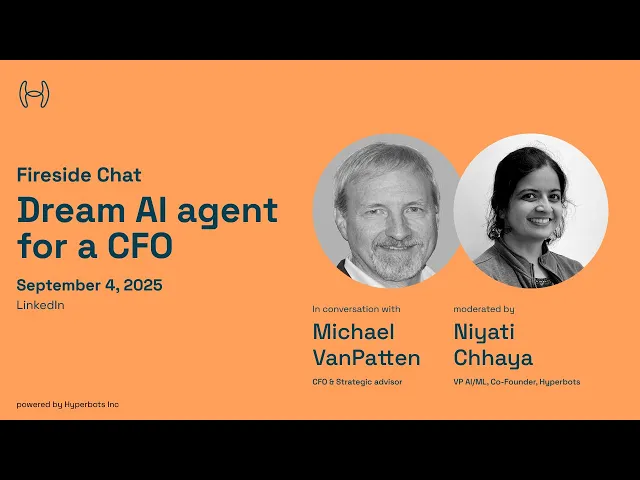
The CFO's Dream AI Agent for Finance with Michael VanPatten
Introduction
If you are a CFO, finance leader, or anyone building tools for the finance function, this conversation is worth your time.
In the seventh edition of our Fireside Chat Series, "The Dream AI Agent for a CFO," we sat down with Michael VanPatten, a CFO and strategic advisor who has led finance teams at technology companies for over 20 years, currently working as a fractional CFO, board advisor, and professor of business at Southern New Hampshire University. Moderated by Niyati Chhaya, Co-founder and VP of AI/ML at Hyperbots, the session covered what finance leadership actually looks like day to day, where the real inefficiencies are, and what an ideal AI agent would do for a CFO who has seen it all.
Michael brings a perspective that is both broad and grounded. He has run finance across multiple organizations, overseen HR and IT alongside the books, sat in board rooms making pricing and acquisition decisions, and now teaches the next generation of business leaders. His take on AI is practical, not evangelical: he uses what works, skips what does not, and is very clear about where AI could meaningfully change how he operates. That clarity is what makes this conversation worth reading.
Key Takeaways
- Combining ERP and CRM data creates more accurate rolling forecasts and revenue visibility.
- Metrics-driven decision making helps CFOs control hiring, spending, and operational efficiency.
- AI is most valuable when it proactively identifies risks, payment delays, and operational blind spots.
- Modern CFOs play a strategic role in pricing, growth planning, and business decision-making.
- The ideal AI agent acts like a proactive finance assistant that monitors goals, trends, and anomalies automatically.
Summary of the Conversation
Meet Michael VanPatten
Niyati: Welcome, Michael. I would love to start by having you introduce yourself.
Michael: Thank you for having me. I have been a CFO for technology companies over the past 20 years. I am currently a fractional CFO for a couple of companies. I sit on several organizational boards, advise other companies, and I teach business courses at Southern New Hampshire University. I am a CPA and I earned my MBA from George Mason University.
Niyati: Wow, I studied at Maryland. I did my masters and PhD at Maryland.
Michael: Okay.
What Does a CFO Actually Do on a Daily Basis?
Niyati: Let us start with what does a CFO or a finance leader actually do on a daily basis?
Michael: It depends on the day. There are always things that come up. But generally, there are tasks that recur. Reviewing month-to-date revenues, cash balances, month-to-date actuals and budget numbers, just to make sure that we are on course to meet our budget for the month and see if there are any corrections that need to be made. Tracking cash against a plan is a good summary.
How Does a CFO Monitor Daily Activities in Practice?
Niyati: How do you monitor all of this? Do you look at slides, reports, Excel sheets? Or is it talking to people, exchanging emails?
Michael: We use various applications. We have an ERP system, we have a CRM system. We created a matrix of those using a product called Domo that brings all those applications together for reports. So I can just look at the menu of the comparison reports that I am most interested in and watch the budget comparisons. One of the nice features of that software is I can set parameters so it alerts me if we are over or above what we are looking for. I also monitor AR and collections to make sure we are growing our cash balance. It is important when you are running a business that you watch cash almost on a daily or weekly basis.
How CFOs Resolve Financial Issues and Operational Risks Quickly
Niyati: Let us say while looking at this information, there is something that you need clarity on. How do you handle that?
Michael: If Salesforce sales forecasts are not met or the contracts are not being completed on time, that sends off an alert and I pick up the phone and start working my way through those issues with the top people in the sales organization to try to determine what the issue is, how are we going to correct it, and when will we be back on schedule.
Niyati: How much of it is email versus phone versus crunching through data?
Michael: It is determined based on the need and the urgency. If it is something I just want feedback on in the next day or two, it will be an email. If it is a little more urgent, I probably send a text to the individuals I want to get a quicker response from. And if that does not work in the timeframe, I pick up the phone. They do not want me to call. So hopefully they will respond before that.
How CFOs Manage Cash Flow Oversight and Financial Controls
Niyati: Does the CFO actually verify large bank transactions or is it more delegated?
Michael: Generally it is delegated to people to watch it and then bring it to my attention if it is not meeting our expectations. Some of the higher-level things I get to see every day. But if there is something down below, I probably would not see it. That is where the delegation comes in. People need to contact me if they see something that is going to go awry in the near future, so we can try to correct it before it happens.
How CFOs Use Financial Metrics to Improve Business Performance
Niyati: Are there pain points that come up frequently in this kind of monitoring?
Michael: I will give you an example. We were hiring people internally to do what our outside vendors were doing, and it was very successful because it increased our gross profit margin from 60 to 80 percent. But we got to the point where we were hiring too many too fast. So we had a metric that showed us the sales revenue produced per employee that we hired in that group. When it started declining, we put a stop on hiring and said, we have a training problem, let us fix that before we hire anybody else. I forced them to get back up to the sales per employee number before they could start hiring again. And then they established better training, better supervision of new employees, and maintained continued growth.
How Are Rolling Forecasts Built and Monitored?
Niyati: What about rolling forecasts? Is that a frequent exercise or something set up in a dashboard and monitored?
Michael: It is monitored very closely. We use the ERP and CRM together. We have customer agreements and contracts that usually last three to six months. The ERP system gives us what we have built so far against the contracts. The CRM gives us the total amount of the contract, subtracts what we have done so far, and forecasts what we still need to do and whether we are on track. We also track future sales through Salesforce at different probability levels, whether it is an 80 percent possibility or a 20 percent possibility, with different expected close dates and start dates. So we know how to spread that revenue from start to finish.
How Are Weekly Meetings and Oversight Managed?
Niyati: How are oversight and reviews managed?
Michael: We generally have weekly briefings for each of the departments. It is to bring up any issues that have arisen from the previous week and any things they flag that they see in the future. We always want to know: is there something we need to fix, is there something we can avoid in the future by making corrective actions? There is an agenda for these meetings and what is critical comes up first. Planning is done more on a monthly basis. I never like meetings more than an hour, so I generally keep them to 30 or 45 minutes.
How Is the Annual Budget Built?
Niyati: Where does compliance come into play in all of this?
Michael: We start in the fourth quarter of the prior year to start building our budgets and forecasts. We start with sales. It is kind of hard to plan expenses until we know what our revenue expectations are. So we take a look at the current year, customers that are going to grow, customers that might go away, new products coming online. Then we go to the expense side. What do we need to accomplish that amount of revenue? If we are going to grow revenue by 80 percent next year, I do not want them to plan more than 40 percent in expenses. And then in the first quarter, if sales goals are not met, we immediately stop expense growth, stop hiring, stop any additional expenses until we hit the revenue number.
Where Does the Knowledge Behind the Numbers Actually Come From?
Niyati: The numbers you are quoting, 80, 40, 30, where does that knowledge sit? Is it expert judgment or is it driven by a financial model?
Michael: We look at historical rates. We know that our fourth quarter is the largest quarter of revenue for the year. First quarter can be the second most, but second and third quarters tend to be weaker. When the sales team forecasts, I make that change or send them the statistics and say, look, you are telling me you are going to grow evenly each of the next four quarters. That is not our history. Go back to the drawing board and come up with something more realistic. We even have it down to the month. Summer months have always been traditionally weak in this business. So a large amount of these decisions are data-driven, based on trends and historical customer behavior.
How Involved Is the CFO in Pricing and Business Strategy?
Niyati: How often do you get involved in business model discussions, things like pricing and target market?
Michael: The CEO generally puts me in charge of all pricing decisions. Sales puts in their two cents, marketing puts in theirs, product management puts in theirs. And we take all that and look at what it means for the bottom line. I push back on marketing. If they are going to spend a lot on advertising, they have to come back and tell me what revenue they are going to generate per product based on that plan. On pricing, I get the final say. If the sales VP or marketing VP do not like it, they can go to the CEO, but he is going to look at the facts and figures I provide on why this is the right price.
What Does the Day-to-Day Time Breakdown Look Like for CFOs?
Niyati: If I had to break down your day into percentages, what does that look like?
Michael: I try to keep meetings down to less than four hours a day and spread them out over the week. Email I check at specific times: first thing in the morning, mid-morning, lunchtime, mid-afternoon, later in the day, and usually at night before I go to bed to see if there are any emergencies. I do not let emails beep my phone because there are too many. A text might alert me to go look at an email. The rest of the day is working with vendors, banks, auditors, looking at software demos, and recruiting. HR reports to me, so if it is a high-level hire I will be one of the last to interview before we make an offer.
How Do CFOs Stay on Top of External News and Market Trends?
Niyati: What about external trends and news, things like tariffs or new regulations? What is your source of information for those?
Michael: Sometimes websites, sometimes just doing searches, Google searches, AI searches on quick topics to see if something piques my interest. I occasionally get things referred to me. Did you see this? Did you see that our competitor did this? A customer is reducing their footprint. So a lot of it is referrals of news articles or things that I need to look at.
Niyati: You do not have a dashboard where you monitor external news coming in?
Michael: Right now I rely mostly on the people around me. I do not have an automated set of requirements for AI to go find me all the news every morning. I do have some of that, but I generally do not spend a lot of time on those things unless it piques my interest. It is mostly referrals from others that I should be attentive to a particular issue.
What AI Tools Do CFOs Currently Use?
Niyati: Do you use any AI tools in addition to the software you have already mentioned?
Michael: I personally use ChatGPT a lot for imaging and some content corrections. I have played around with the Microsoft product with PowerPoint and Excel. Sometimes it works, sometimes it does not. But I am constantly challenging those things to see when they can be effective for me. If it does not give me the results I need, I go do it manually. I use it more for marketing purposes than to rely on it for core business decisions at this point.
What Would an Ideal AI-Powered Workspace for CFOs Look Like?
Niyati: What features or functionalities would you like to see in an AI-powered workspace you looked at every morning?
Michael: On the budget side, how are we tracking against budget? Are we paying our vendors on time, especially the critical ones. I always believed in the ABC analysis. Some vendors are more important than others and you do not want to miss a payment. And make sure key customers are paying us. Aged accounts receivable: it is great if AI can just tell us which ones are not following their normal payment schedule. If they are usually paying in 30 days and all of a sudden it is 45, we should probably do something instead of waiting for it to show up on a report at 60 days. Also, if there are early payment discounts we can take advantage of, that is always helpful to monitor and execute on faster. And watching cash balances in the bank accounts daily so I can see if something is not flowing appropriately.
What Tasks Make CFOs Wish AI Could Just Handle Them Automatically?
Niyati: In the last few weeks or days, have you come across tasks where you felt, I wish AI would just do this?
Michael: Probably information on where we are not looking, so to speak. What are we monitoring? What other areas should we be looking at? Once you are up and running and operations seem smooth, sometimes you get to a point where you are not paying attention. And I think something like a bot could give us ideas for improvements by looking at our history and saying, you could improve by doing this. I like alerts. I do not like having to go looking for things. AI could probably create even more alerts for me and let me know further ahead. It could say, okay, this is not urgent, but you need to look at this in the next day or two before it becomes urgent. That would be very helpful.
What Does Your Dream AI Agent for a CFO Look Like?
Niyati: And the last question. What does your dream AI agent for a CFO look like?
Michael: I am a very goal-oriented person. I like all my direct reports to have objectives. I would love to have AI monitor all those objectives for me instead of me having to go find out if this person accomplished something on a certain day. It would be very nice if AI could work with me to create the objectives for each individual and then monitor those objectives on a daily basis to see where they are at, or at least weekly. And if the objective is no longer valid, because we changed the position or reduced staff or something, AI should be smart enough to know we have to change that objective. It could monitor the business to make sure the objectives are still valid on almost a daily or weekly basis.
Niyati: Any final thoughts?
Michael: The rumors out there that AI is going to eliminate everybody's jobs is not true. I think it is going to improve everybody's job who uses it. So I highly recommend everybody use AI tools, figure out how to communicate with them, how to make them better and how they can make you better. I think even software development is probably going to be the biggest area. We can tell AI what we want, it generates the code, and now we need people who can test and verify it. It is going to improve everything, make things go faster, and help us improve our systems and our decision-making in the future.
How Hyperbots Is Helping CFOs Today
Much of what Michael described, watching accounts receivable for payment pattern changes, catching vendor payment timing, monitoring cash flow in near real time, represents the exact gap between where finance teams are today and where they need to be.
Hyperbots' AI co-pilots work directly in those gaps. The Invoice Processing Co-Pilot delivers 99.8% extraction accuracy and 80% straight-through processing, so the manual work around invoices that still consumes finance team time gets handled automatically. On collections, Hyperbots brings a 70% cost reduction and a 40% improvement in DSO, addressing precisely what Michael flagged as a daily monitoring priority: knowing which customers are slipping on payment before it shows up as a problem at 60 days.
The CFO of the future is not going to win by having better reports. They are going to win by having a system that tells them what matters, before they even have to ask.
See it in action with a demo or start your free trial today.