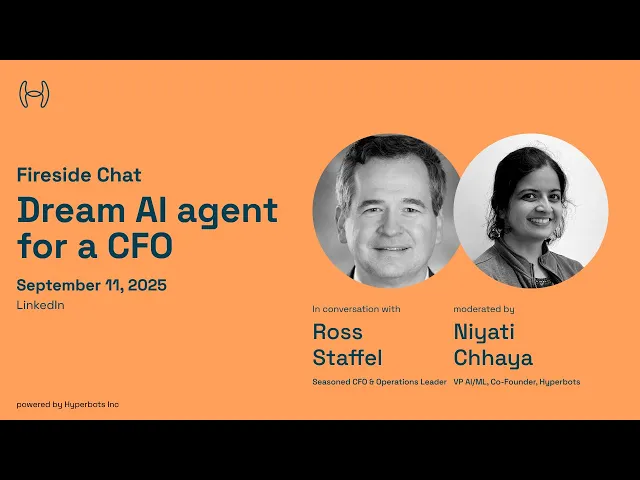
Fireside Chat: The CFO's Dream AI Agent for Finance with Ross Staffel
Introduction
If you are a CFO, controller, or finance leader trying to understand where AI actually fits into your work and where it does not yet, this conversation is for you.
In the eighth edition of our Fireside Chat Series, "The Dream AI Agent for a CFO," we sat down with Ross Staffel, a seasoned CFO and operations leader with over 30 years of experience across finance, strategy, risk management, and technology-enabled transformation. Ross has led finance teams through M&A, built reporting infrastructure from scratch, managed multi-jurisdiction compliance, and most recently served as CFO at RM2, a publicly traded IoT supply chain company, before moving into a consulting CFO role at NOW CFO. Moderated by Niyati Chhaya, Co-founder and VP of AI/ML at Hyperbots, the session was one of the most technically grounded conversations in this series.
Ross is not skeptical of AI. He holds post-graduate credentials in Generative AI from UT Austin and has completed MIT Sloan's program on AI and business strategy. But he is precise about what AI needs to earn to be trusted in finance: security, auditability, and governance. That precision is what makes his perspective worth reading carefully.
Key Takeaways
- The biggest drain on CFO productivity is not analysis itself, but pulling fragmented financial data from disconnected systems into one usable view.
- Even the most advanced finance teams still rely on Excel for final forecasting because flexibility matters more than replacing existing workflows.
- AI adoption in finance will succeed only if security, auditability, and governance are designed into the system before deployment.
- Budgeting and forecasting are ideal AI use cases because finance teams spend enormous time testing assumptions, building scenarios, and validating variables manually.
- Continuous AI-driven fraud monitoring and anomaly detection can give CFOs visibility that manual reviews and periodic audits often miss.
- The best way to adopt AI in finance is to identify a painful operational problem first, then deploy targeted automation with measurable ROI.
Interview Summary
Meet Ross Staffel
Niyati: Today I have Ross with us, who is a seasoned finance leader and CFO, operations leader with over 30 years of experience and expertise in finance, strategy, and technology enablement. Ross, through his career, has led organizations for M&A, risk management, and AI-driven transformations. Welcome, Ross.
Ross: Yes, thank you for having me. Pleasure to be here.
What Does a CFO or Finance Leader Actually Do Every Day?
Niyati: What kind of daily tasks does a CFO or a finance leader have? What does this person usually do every day?
Ross: I try to break it down into some key areas. First is financial oversight and monitoring: understanding cash flow, liquidity, working capital. Then strategic decision support, which is the financial reporting and analysis for stakeholders and users of financial information. Then risk, compliance, and governance: understanding risk exposures, GAAP compliance, ensuring financials are compliant with local, state, and tax authorities, and understanding how those change going forward. And then the last area is growth and innovation: developing cost-saving initiatives, identifying opportunities for efficiencies and projects, certainly revolving around IT and information systems as well.
Where Does Most of a CFO's Time Actually Go?
Niyati: Where do you spend most of your time? Is it looking at reports, making slides, gathering information, reviewing it?
Ross: I think it is kind of all of those. Depending on what day of the month and time of the year it is, the mix varies. But certainly you have daily requests that come in from various departments, information that can be ascertained but you may not readily have. So you have to go back to other folks or departments to gather it in order to respond.
Top of mind for me is always: what is our cash position? Being able to accurately forecast and having the right amount of cash at the right time in the right place is extremely important. And then being able to provide in-depth analysis into the financials. A lot of that time, even before you release financials, effort goes in pre-close. And then you get requests for additional detail or data to understand trends. Some tasks are more routine, just responding or filtering information and getting the right information from the right folks to the right people. But oftentimes that information is not in a readily accessible place. You have to dig it out to be able to respond.
How CFOs Verify Cash Flow Accuracy?
Niyati: Can you give an example of verifying actual cash flow information? What does that take?
Ross: On a first level it is really ensuring everything is posted. If you are looking at it on a weekly basis, making sure your cash receipts have been posted. A lot of times you get a lot of activity at the end of the week, a compressed timeline to generate reports and build a rolling forecast. You are pulling data into a common file: your banking information, payables, what cash receipts came in, forecasting what you anticipate being received from customers, and what payments you have upcoming.
Then analyzing: we were expecting a payment from this customer and it did not come in, is it just a timing thing or is something larger happening? Or maybe we had unexpected expenses that were not budgeted at the time, ad hoc payments we have to account for in the week. Those are some of the challenges you face.
Why CFOs Still Rely on Excel for Financial Forecasting
Niyati: Is the forecast done on Excel sheets or are there tools typically used?
Ross: For us, most of the time the final iteration is in an Excel file. Excel is very flexible. There are different tools that you can use to populate an Excel file, but you have to build those tools out. For us it is just a rolling Excel file forecast. There are certain other tools built into an ERP system or used in a cash flow model, and sometimes those are great. But the advantage of Excel is the flexibility, being able to adjust for things. It can also become larger than ideal if you have a lot of variables you need to validate to ensure accuracy.
What Documents Does a CFO Review Regularly?
Niyati: What are the documents you frequently look at as a finance leader? Is it just balance sheets, or are there other things?
Ross: There are a number of defined or set metrics. You have your financial statements: balance sheet, income statement, and cash flow statement. Then breaking it down into operational cash flows, looking at operating margins for your product mix, and understanding variances from the previous month, comparing actuals to forecasted amounts. A lot of times some of the data resides in an ERP system, which is accounting-centric for payables and receivables. Sometimes billing information has a separate billing system. So pulling the detailed information often requires getting it from a more detailed source that may roll up into your ERP system. The data can be siloed. Ultimately it is nice to have it all in what you call a data lake, where you can access it and have the detail already there.
How CFOs Manage Contracts, Compliance, and Regulatory Changes Across Markets
Niyati: Do you also look at contracts, SOWs, or compliance-related documents?
Ross: Yes. As far as compliance, you want to ensure that whatever contractual agreements you have with your customers and suppliers are being met. That could be pricing with vendors to ensure they are giving you the contractually agreed pricing. If there are billing disputes with customers you always have to go back and refer to the contractual agreement.
For other compliance issues, the challenge is just staying abreast of regulatory changes. That could be tax issues. If you operate in various tax jurisdictions, whether international, state, and federal, you always want to keep up with those. I rely a lot on external consulting to stay abreast of many of those things and to incorporate anticipated changes internally. With GAAP, things that are being anticipated and may take time to prepare for, it is always important to know they are happening and that they could affect your company.
Does the CFO Monitor Bank Transactions Directly?
Niyati: Do you monitor bank transactions at all, or is that completely delegated?
Ross: No, I just monitor it. Cash flow is always top of mind. Even if you just go in and look at the balances and see what is in and out, depending on your internal controls and levels of authority for approvals, there are always different levels that require approvals. I always like to know what our cash position is at all times. I may look at it on a daily basis, but at the end of the week I try to understand the trend and what is happening. Some companies have an independent treasury management department more able to devote resources to monitoring those things, but I think every CFO wants to know where the cash is and how they are doing.
Niyati: Do you look at the bank portal or the statements the bank sends?
Ross: Just strictly through the portal. Every bank system has pretty sophisticated banking portals. We do not do any paper check transactions. Most everything is ACH and wire transfers.
How Involved Is the CFO in Business Strategy and Pricing?
Niyati: Do you get involved in business model discussions with the CEO, things like pricing, target market, product fit?
Ross: Sure. Especially for forecasting future changes in product mix, customers, or costs, those all go into a forecast or budget. For me it is more of a top-down approach. Try to understand what your sales forecast looks like, what the product mix is, what costs are going to be incurred with that product mix or sales volume. Then breaking that down into direct costs, variable costs, fixed costs, administrative costs, going through it line by line throughout the organization.
Then you have different scenarios. If we increase sales by this percent, how does that impact costs? Are there areas we can look at to increase efficiencies? If we invest in this technology or a new piece of plant equipment, how are we going to get a return on that investment, and how is it going to impact cash flow and contribution margin?
What Does the CFO Enjoy Most About the Role?
Niyati: Out of all these tasks, what do you enjoy the most?
Ross: I think everyone who is a producer of financial data and information wants to be able to provide useful data to users and be able to anticipate changes or market conditions, understanding how to make financial information more impactful or meaningful to the sales organization or to operations. When you can see it is making an impact on decisions for the company, that is fulfilling. The challenge is making it timely and in enough detail and with different scenarios to help run an organization. Those are the areas where the CFO and financial folks can have the most impact outside of their own department, which is really what organizations are looking for. The challenge is not only keeping up with the close, but having the right data and information so that you can understand the analysis and what is happening.
How CFOs Manage Financial Close, Reporting Deadlines, and Audit Preparation
Niyati: What are the tools you use daily? And how do you track all the calendar-driven deadlines in finance?
Ross: There are usually set deadlines for different types of reporting. Cash flow is typically weekly, or even daily on an ad hoc basis, but weekly is the more formal reporting timeframe. Then it revolves around month-end reporting: going through a pre-close, ensuring everyone who needs to be invoiced has been invoiced, that materials received into inventory have been accrued, and that you have received the bills of lading. There are various deadlines along the way that have to be met in order to close. And then you have audit, which is a year-end deadline you start preparing for by the end of the third quarter or earlier. Then tax deadlines, whether that is monthly sales tax, annual federal tax returns, franchise tax reporting. So to answer your question, the short answer is you have to have a checklist to help manage it.
As for tools, Excel is probably the most used. Email, PowerPoint, and then the ERP system. I like to be able to access a lot of the detailed information directly so I do not have to add that to someone else's task. Sometimes the challenge is that a lot of data does not get fully entered until the end of the month, and if you are trying to access what is happening on this day or this week, sometimes not all of the information has been posted yet.
What AI Tools Are CFOs Using Today?
Niyati: Do you use any AI-based tools in your work today?
Ross: So basically around robotic process automation, being able to match supplier invoices with delivery bill of lading documents and then putting that in a batch file that can be posted, and then determining if there are exceptions that require someone to review. If your PO, delivery documents, and the invoice you receive have discrepancies or mismatches, those get kicked out. But those are the basic things most companies can benefit from immediately: taking the routine transactions around payables and receivables that do not require much judgment and just need entering and posting, and allowing personnel to work on the exceptions that require further investigation.
I also use AI on a more ad hoc basis for financial analysis. Taking a financial forecast report and asking an AI to take it apart, look at it, look for anything unusual, trends, those types of things. Producing insight into financial information in a very timely fashion is always the challenge. Any opportunity to automate some of those back-end processes helps achieve those goals.
How Do CFOs Track External Trends and Market Signals?
Niyati: How often do you look at external sources, things like news, interest rates, tariffs?
Ross: It is very important. There is a myriad of things you want to be aware of. Interest rates, the economic forecast or conditions being anticipated, tariffs, which have been a big area of concern and understanding how they are going to impact costs. And you can go back even further to COVID and the supply chain disruptions: first you had the disruptions and then it took a long time for some areas of the supply chain to reset and reestablish itself because of material shortages. You are always wanting to know how that impacts your suppliers and what is going to happen externally. Even changes in regulatory frameworks that might create new market opportunities are extremely important to monitor.
For me those are more about staying abreast. You get a lot of data and you have to filter it and understand whether this could potentially impact the company or the future, or whether you need to account for these risks and opportunities. As far as having a formal system to help identify and determine that, it is more reliant on your own judgment and consultants. Tax folks usually have access to information about what is happening on a regulatory basis long before it ever becomes a law or a change in GAAP. They often have access to what is happening in committees and can flag things early.
What Would the Ideal AI-Powered Workspace for CFOs Look Like?
Niyati: Let us say you had an AI-powered workspace to start your day. What features or functionalities would you want to see?
Ross: I think initially it is really being able to handle routine tasks. It could be just helping manage emails, gathering information on a routine basis so that you do not have to, automating different reporting tools. Everyone has tasks that are routine but basic, and then more value-added things that require actual judgment, whether it is investigating different analysis or dealing with different issues. A lot of times you are responding to requests for data and information. It would be nice to give a voice command and say, handle this information, go find this data, I need to put together a response in short order. Freeing up time to do more analytical analysis, forecasting, and strategic thought leadership is where you want your time spent.
Why CFOs Still Want Human Oversight Over AI-Generated Decisions and Responses
Niyati: Would you be okay if your AI went in, drafted the answer, and said, can I just send it out?
Ross: Yeah, I think for me there are always security concerns and auditability of these types of systems, but really making sure that your data is secure. From my personal perspective, I find a lot of value in AI being able to do a lot of things and then coming back and saying, this is what I found, or here is how I would respond to this email, but giving me that final say. To ensure consistency, I think it needs to come from the person. If an email is directed to you and they are asking you a specific question, you can delegate finding the answer or how to respond, but the response needs to come from that person. I would still want to see it. Even though the responses could be as good or better, at this stage you still want that oversight. Just turning it over without any oversight is going to raise audit concerns. Who is monitoring this? Who is looking at it to ensure it is giving the correct responses?
What CFOs Need From AI Security, Governance, and Audit Controls
Niyati: What level of guarantee would you want AI to give you around privacy and security of your data?
Ross: For financial data, you want to make sure that the workspace the AI is operating in is secure and contained. You do not want that information to leak out. That is a big concern for a lot of folks. If you give a tool access to that data, you want to ensure it is using the data in the manner you intended and it is not going to somehow leak out to the internet. Not only do you want to know that as a company, but your auditors are going to want to know it too. How did you demonstrate that this data is secure, that your environment is secure, and that the results the AI is generating are what you anticipated?
You have to have AI governance to help guide that. If you have an agent that performs certain tasks, just say it is a reconciliation or payables automation, your auditor is going to want to know how the company got comfortable using it, what the checks and balances are, and how you ensure it is giving the right results. Maybe you have an agent do certain tasks and then someone goes and tests it, pulling some receipts or invoices to ensure it is providing the results you want. That is kind of the best practice way to approach it.
How CFOs Want AI to Automate Budgeting, Forecasting, and Scenario Analysis
Niyati: Did you come across a task in the past few weeks where you felt, I need an AI assistant to do this rather than me doing it?
Ross: I think the real benefit is around budgeting and forecasting. A forecast or budget takes a long time to build up with a lot of information and a lot of variables. It would be great to put in various scenarios and have it run the different scenarios and give you different outputs, to analyze what-if analysis. If I had an increase in sales, or if our costs went up by this amount, to be able to communicate that directly and have it go perform those tasks. You could take your budget or forecast, put it into a system, have it pull historical information, take your inputs from your various functional areas, do analysis on it, and say, these assumptions make sense, or you may want to look at this. Those are some real promising areas.
What Does Your Dream AI Agent for a CFO Look Like?
Niyati: What does your dream AI agent look like? And what keeps you up at night?
Ross: Building on the basics of AR and AP automation, then around close, being able to automate your financial close and reporting. The demand is always for more timely information that is also accurate. If you can achieve both at the same time, those are really great things. Audit and compliance monitoring is another great area where you could have an agent going out and looking at your data on a regular basis. Cash flow forecasting is another area where you can pull the data from your systems and use it to develop your forecast. And then fraud detection, having an agent that can look at different transactions on a continual basis instead of at various points in time, because a lot of times you do not always have the resources to devote to that. Having something continuously looking at it and putting the appropriate oversight to that would be a dream.
What keeps me up at night? Really just cash flow and liquidity. You always want to make sure you can meet your financial obligations. And then balancing your short-term expectations with your long-term growth plans and making sure those are aligned. And compliance, making sure you do not have any surprises there.
For anyone looking at AI, regardless of where you are on that journey, start looking at it. Start with basic things and build on that. Have an AI governance document that determines who is going to be deciding which projects and which areas you are going to move forward with, and the order in which you do that. And do an internal analysis to look at what areas of your company you feel like, I really wish we had something that could do this or that. Look at the problem first and then look at what the solution would be. By determining what you want to accomplish, it is easier to measure your return and the efficiencies, and then take a strategic approach to using artificial intelligence.
How Hyperbots Is Helping CFOs Today
Ross described a set of challenges that are very recognizable across the finance function: invoices that need to be matched against delivery documents, payables that should not require manual entry, cash flow that needs to be visible in near real time, and anomalies that should be surfaced before they show up in a report at the wrong moment.
Hyperbots' co-pilots are built specifically for these workflows. On invoice processing, Hyperbots delivers 99.8% extraction accuracy and 80% straight-through processing, handling the routine matching and posting that currently takes up personnel time and routing only genuine exceptions for human review. The Procurement Co-Pilot compresses the PR-to-PO cycle to under five minutes, with an 80% reduction in creation and dispatch time. The governance and auditability that Ross emphasized are built in: every decision the system makes is traceable, which is exactly what your auditors will ask for.
For CFOs who want to start small and build, the way Ross recommended, that is precisely how Hyperbots is designed to be deployed. The Accruals Co-Pilot is a strong starting point for teams looking to cut manual month-end work immediately, with less than 5% variance between accrued and actual costs.
See it in action with a demo or start your free trial today.