The CFO's Dream AI Agent for Finance with Jon Naseath
Introduction
If you are a CFO, finance leader, or anyone building tools for the office of finance, and you want to understand what the role actually demands beyond the job description, this conversation is for you.
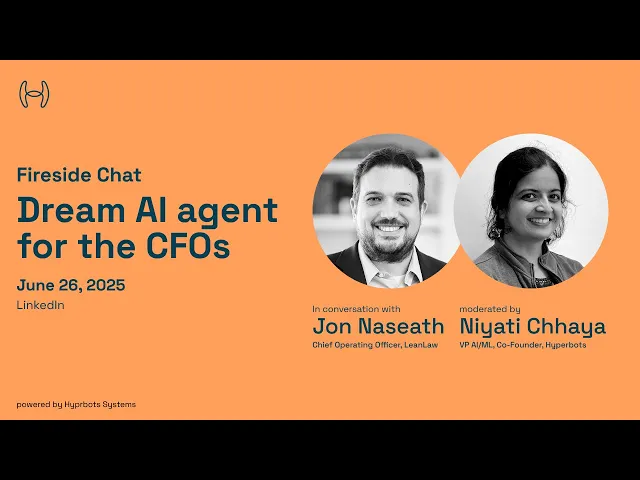
In the first edition of the Hyperbots Fireside Chat series, "The Dream AI Agent for a CFO," we sat down with Jon Naseath, COO at LeanLaw. Jon is one of those rare finance leaders who came up through the technical side of the business first. He holds a master's in information systems, spent six years at KPMG where he also earned his CPA, and then moved through data analytics, risk, and compliance work before growing into CFO roles across companies of different sizes and stages. More recently, he has added a Certified Fraud Examiner credential to that background. That combination of technical depth, accounting rigor, and hands-on CFO experience gives him a perspective on AI in finance that is both grounded and genuinely forward-looking.
Moderated by Niyati Chhaya, Co-founder and VP of AI/ML at Hyperbots, the session covered what the CFO role really looks like day to day, why free cash flow is the metric that ties everything together, how compliance and audit relationships actually work in practice, and what a genuinely useful AI agent for a finance leader would need to do. Jon also brought in something that rarely surfaces in these conversations: an honest account of where AI tools have already fallen short for him, and what would have to be different for them to actually earn trust.
Jon came into the conversation as someone who had literally just spent three months transforming LeanLaw's finance operations from ad hoc to nearly dynamic, moving across the full maturity curve in a single quarter. That on-the-ground freshness ran through everything he said.
Key Takeaways
- The CFO’s single most important responsibility is protecting the accuracy of the financial forecast because every operational decision eventually impacts it.
- Free cash flow gives CFOs visibility across the P&L, balance sheet, and working capital simultaneously, making it more important than net income alone.
- The best CFOs do not own every metric themselves. They ensure every forecast driver has accountability tied to the business function responsible for it.
- AI becomes valuable when it surfaces hidden operational risks and blind spots before they appear in the monthly close or financial statements.
- Continuous AI-driven compliance monitoring could become a competitive advantage in fundraising and investor trust, not just an operational improvement.
- The biggest barrier to AI adoption in finance is not technology or cost, but whether people inside the organization are willing to adapt and change.
The Conversation
What Does a CFO Actually Do Every Day?
Niyati: All right, so let's just say, what do you do every day? What are the key tasks that you worry about? I woke up in the morning, got up, went to the office. What happens next?
Jon: As a CFO role, what was surprising when I first became a CFO is how different that is than even a director or a controller or someone doing AR or AP or banking. There are all these different roles in finance and the CFO role is different. I've done it now a few different times in different companies and different sizes.
The shortest answer is you own the financial forecast. And I remember talking to someone saying, we can screw up on lots of other things. You can drop the ball on a billing or a different thing, but you cannot screw up on the financial forecast. So really it's about, there's a cadence around quarterly planning and then monthly plan versus actuals updates. But on a daily basis, whatever you need to be doing to help enable and have a more accurate financial forecast is the answer.
That's really your key job, is to fix and enable supporting what you said you were going to do and then understanding what you need to forecast next time around driving that. Now, there are other parts of the CFO's role, like raising capital and signing off on audits and all these other things, and I would describe those as again things that enable the financial forecast. You have to have the forecast right so you can raise money. You could argue yes, you have an FP&A person that helps you with that. But bottom line, I'll stick with it: you own the financial forecast and you've got to make sure you're delivering on that.
How Every Metric in the Business Ties Back to the Forecast
Niyati: When you say you own the financial forecast, do you kind of review metrics every day? Do you look at dashboards or is it more of talking to people, talking to your team, figuring out what's going on and tracking things?
Jon: Yes. And in my mind, I'm talking about that financial forecast as the output, the final output of a long stream of things that happen to enable that. Think about all the input drivers. And so you have metrics around those drivers. You'll have someone whose job is accounts receivable or their job is treasury. And what was interesting to me before I was a CFO, and then actually as a CFO, is that because you're so focused, I can see in my mind how every metric in the business ties back to that financial forecast. So when something is escalated to me, like approve this new vendor, I know exactly how that's going to impact the financial forecast. I know if I have cushion for that to add that vendor, or I know if I have to negotiate harder to get additional savings because someone else in the organization is doing something and I need to create capacity for that other new hire in the other part of the organization.
And it's probably the only role that has that complete holistic look at what is leading into that financial forecast. I know, for example, are we light on our sales numbers? So we're going to not have enough, but I need to solve for profitable margin by the end of the quarter. So I need to find ways to save money in other places so that we can still hit free cash flow positive, or free cash flow forecast targets, whatever we said they were going to be.
Why CFOs Treat Free Cash Flow as the Ultimate Measure of Business Health
Niyati: How do you monitor cash flow? And when you say forecast, what does that actually mean in practice?
Jon: When I said forecast, for me what I'm really talking about is free cash flow. Because there's obviously, think about your way down the P&L, there's like revenue and you can go down to gross profit, contribution margin. You can even say operating profit and you can say net income. People think, oh, net income is the bottom of it. But I actually like going below that, adjusting from EBITDA with working capital to free cash flow. That's kind of my bottom line. So I'm solving the whole stack of the P&L with working capital down to whatever we're doing, how is that going to impact free cash flow. And you could argue that like five years ago companies were just focused on top line revenue, and then companies focused on gross profit or contribution margin. I've learned through experience that free cash flow is really what I need to be solving for consistently.
Niyati: And so essentially your playground is the P&L, and that information is populated somehow. How do you track the working capital?
Jon: Let me clarify the point of down to free cash flow. The way you get to free cash flow is that it should tie with the change in your balance sheet. So if you have a change in your balance sheet period over period, that should equal what is free cash flow. And they're both calculated differently, but that's why it's such a powerful metric. It actually allows me visibility into what's happening in the P&L and visibility into what's happening in my balance sheet. And so if those numbers don't tie, I know that there's something I'm not understanding on working capital, which is really the change in periods from AR, AP, inventory, treasury. As those things are changing on the balance sheet, if I'm navigating down to free cash flow on the P&L, I'm actually able to understand all three financial statements: balance sheet, P&L, and cash flow statement. And there's not really anyone else in the organization who has the full concern on all those levers and how they all fit together.
How CFOs Use Forecasting Tools, ERP Systems, and Spreadsheets Together
Niyati: And I'm guessing all of this is done predominantly in Excel sheets or large accounting software?
Jon: All of the above. I have this technology background, so that's really my passion, getting it to where it's all fully automated. And then I want the systems to give me the insights out of the box. But usually you'll have your accounting, which is looking backwards in your ERP accounting system. But then we're talking about a forecast, and that is oftentimes done in a P&L spreadsheet. I've used Anaplan. I've used lots of different planning software. Getting the baseline of those forecasts into the ERP is possible but just difficult to manage. So yes, it usually ends up in a spreadsheet. And the data rarely is available across all systems. In the CFO role I'm considering the annual forecast, the quarterly forecast, the monthly, and depending on the size of the organization or the cash position, sometimes I have to worry about weekly payroll numbers. It's a lot of data to always have your head wrapped around.
And what's interesting specifically about the CFO role is I can look at a number from anywhere in the organization and I know when it's wrong. When I was a controller or VP of finance, it surprised me. I was working for a great CFO, Keith Taylor at Equinix, and he could look at numbers I prepared where I spent a lot of time preparing them, and he could just say, there's something wrong in that number right there. I didn't understand how he could just pull that out and see it. But as a CFO you can. And I asked him one time, how do you do that? And it's because when you're so in the weeds of a particular part of the process, sometimes just coming in with fresh eyes and knowing what we said last time to investors, you can see what's different from what we just told them. Think of it like someone standing on the tower looking at what's happening versus someone fighting in the field. You can see
stuff differently.
Revenue Is the Most Important Metric of All
Niyati: So basically, get all the data together, look at the insights, keep an eye on the working capital, the spend, keep an eye on all these processes, and essentially have a hawkeye view from up there. Yes, you just listed a list of different areas of the business. Is there one that's most important?
Jon: It would be inaccurate if I didn't describe the most important one. One metric, one area of what impacts the financials the most. You can talk about cash, call that at the bottom of everything, free cash flow. But I'm going to say revenue, sales. The CFO cares deeply about sales, because to the degree that sales are happening and we're hitting our growth numbers, that's the biggest driver of your forecast overall. And to the degree that it's not, then you have to focus on growth, do we have enough cash? A lot of other problems can be solved if you're hitting your sales numbers. And some of the easiest ways to resolve free cash flow challenges, or to have problems if these aren't resolved, is the way you structure deals, the way your salespeople are doing their deal desk, and if they're giving away big discounts or not being aggressive enough in their sales levers. I just want to emphasize that sales and revenue is critical to the CFO.
How Involved a CFO Gets in Business Strategy and Pricing
Niyati: How involved do you get into these business model discussions? Pricing, target markets, maybe even going all the way to sales and marketing as a function?
Jon: And as you said in the introduction, I'm a little bit different than other CFOs. I've actually had that feedback as I've worked with CEOs. I come in, a lot of times I've been hired into a role for a CFO because they want someone who can help manage the board, who can create the forecast, who can do that really pure CFO type role. But then the way that I'm able to help achieve those financial results is I like going back and engaging with the head of sales, the head of engineering, the different owners of those different drivers that lead into the financial results. From my point of view, financials are an output of the operations.
And I'd say I'm very involved, but it's important to respect their role. The key point is, as the CFO, the investors and the board are going to hold you accountable if the numbers are significantly off. And oftentimes the CFO role can be a revolving chair if the numbers are missed. So in order to protect that role and protect myself, what I like to do is have every number, every leading indicator into that forecast, owned by someone in the business. I make sure that they know that, that the board knows that, that everybody knows this is the sales number coming from sales. And I'm going to do everything possible to help them achieve that, but they're really the right ones to define that number. And as a CFO, what I'll also do is build in cushion, the fancy word is contingency, into the forecast to protect everyone else but also to protect the role and the accuracy of what I'm forecasting.
How CFOs Identify the Metrics That Actually Matter to Boards and Investors
Niyati: How do you do that? You're talking to a lot of people, understanding their metrics, mapping those things, attributing everything on the balance sheet and the P&L, and then doing the communication. How much of that is in-person discussions versus tools versus number crunching?
Jon: The way I became a CFO was by doing what you just described. Let me touch briefly on the background because it'll help explain the story. So yeah, master's in information systems, technology focused. For me, it's all about the data. But then I was working at KPMG for six years and I realized I might as well get my CPA because otherwise it'll just seem odd. So I got my CPA. Then I was hired into a large organization helping with data analytics and risk compliance.
It just reached a point where I was solving financial problems and I was trying to figure out the answer to this question: there are so many metrics across the organization that you could argue are important, and they are important for operational leaders. But what I did was I went to the CFO, I went to the board, and I said, what are the numbers they're reporting regularly? What are the ones they care about? What are the direct leading indicators to that financial forecast?
And I traced it back to the key metrics that directly tie to that board, auditor, and financial statement numbers. So of maybe hundreds of operational metrics, by focusing on the ones that have a direct line I can tie to that financial forecast, those are the ones I focus on. And it actually became very powerful and really helped those operational leaders. Marketing, you can talk about all the things that marketing wants to do. But if I really focus on what is the return on ad spend, what is the cost of acquisition, what is the customer lifetime value for sales, that helps define how much we're going to be able to give as commissions. By identifying those metrics for those operating groups, it really helps focus and enable less metrics for reporting.
How CFOs Manage Annual, Quarterly, Monthly, and Daily Financial Forecasting
Niyati: How frequently do you do such work? Are there certain forecasts you prefer to do at a slower cadence, certain things done weekly? How does your calendar look if I were to make a calendar of just doing the forecasting activity?
Jon: Finance is really driven by the calendar. Like it's all about the calendar. So you have an annual forecast, and oftentimes they'll do strategic planning starting in August, September, October timeframe, because by the end of the year you have to have locked in the new budgets, the new forecast for the year. In that strategic planning, you're doing a three or five year forward planning. And after you lock in the three or five year kind of goalposts, you have to take that down to department level P&Ls or functional cost center P&Ls, so that by December you've got an annual forecast. And there's always the dream of having the rolling annual forecast. I like having a forward-looking 12 month forecast.
Then with that baseline you're doing quarterly forecasts and quarterly plans. We talk about a three plus nine and a six plus six and a nine plus three as far as months of actuals versus months of forecast. So every quarter I have a re-forecast that I'll usually do in the second or third month of the quarter. And within the quarter I'm talking about a monthly calendar and the monthly close, but I don't have time to be re-forecasting everything each month. I'll have a trajectory view of seeing where I'm going, but it's all about landing that quarter's numbers when I'm within the quarter. And at the end of the quarter, I'm re-forecasting how I'm going to land the year.
And the last point to what you just described: if you think about the different metrics, there's a timeliness to them. Financial close metrics are only available once a month, so I only really look at those monthly. There are accounts receivable, AP, revenue, sales numbers that are available more frequently, and I'll look at those weekly or sometimes daily. Usually you make payments to vendors once a week, so maybe on Thursday I'm going to review what payments are going to be made on Friday. By looking at what the cadence is of the metrics, I can really schedule myself what I need to look at when. That's how you do it.
How CFOs Manage Cash Flow, Vendor Payments, and Financial Risk
Niyati: As a CFO, do you actually monitor large bank transactions and approve them, or is that delegated to function owners?
Jon: Do the payment, don't do the payment. That's entirely driven based on the cash position of the company and how much cash you have available in cushion. Ideally as the CFO I'd love to focus on strategy and forward-looking and sales. But the key trigger is whether we have to start deciding who we're going to pay this payment cycle and who we're not going to be able to pay.
I've been in two situations where I was managing companies that were coming out of bankruptcy. The easiest way to identify and answer your question is: if you have say a million dollars sitting in cash in the bank and you're just paying vendors, you can just tell your accounts payable, pay our vendors, and I'm going to manage on a monthly basis and make adjustments. But if you start getting into what's usually affectionately called stretching vendor payments, and we're going to have to by default stretch vendor payments a little longer, or start individually picking out who are we going to be able to pay, that's where the CFO should really get involved. Because if you just don't have the money to pay all your vendors, you're basically placing bets on who's going to blow up and how mad they're going to be. And the key point: you want to protect which vendors you have to pay because what you're protecting is making sure you can pay payroll and making sure you can pay your critical vendors. That if you stop paying them, your whole business stops. That's where ideally the CFO should not have to be involved, that's treasury, that's accounts payable, but it happens.
Why Financial Integrity and Compliance Matter More Than Forecast Accuracy for CFOs
Niyati: Where does compliance come into play for you? Is it something like a new policy is released and you wake up in the middle of the night, or is it something you need to worry about on an ongoing basis?
Jon: Well, as a CFO, worry is a careful word. But I'd say the CFO should always be worried about compliance, should always be aware of compliance, and expect compliance. Because it's just not acceptable from a board perspective or from investor perspective if there's something that isn't complying. Bluntly, I'm also a certified fraud examiner. I've done forensics audits. If I smell something that's not right, let me clarify something I said earlier. I said that the forecast is the most important thing. That's only because integrity is assumed. There's no question about integrity. There's no flexibility there. It's just not worth it. As the CFO you're the one who has to protect the whole organization from making costly mistakes. And you can't bend in your integrity. It's not worth it.
Niyati: And what do you do when you have too many regulatory agencies to worry about? As you grow, you deal with multiple markets. Then what happens?
Jon: Yeah, this is being recorded for posterity's sake, so we'll see if an auditor comes and calls me on this at some point. But I'll stand by my answer.
There are two aspects of compliance. There's compliance because there's a risk that we're trying to mitigate that's bad, something that's really going to impact investors or the business. So I'll call it a genuine problem. And from that perspective, I love having someone come in and review what we're doing because it looks at stuff at a more detailed level than I might have been aware of. Now, as part of my role as CFO, I'm going to make sure my team makes sure that those sorts of risks, we're not dependent on an auditor coming in to find those. We're not doing those things because an auditor is going to come look at it. We're doing those things because they're the right things to do to mitigate the risk of our business. So my first point is: you don't let the auditors control your business. You're not doing something in your business because the auditor told you to. You're doing something because I'm the leader of the business and I say that's the right thing to do.
That's an important distinction because especially when you have big PwC, KPMG coming in and they're going to start telling you what you need to do. I've observed lots of situations where an auditor comes in and finds something that doesn't match the control design criteria. And so they might call that a control deficiency. But then even though you might start out with a list of a dozen different control deficiencies, it comes down to a discussion hopefully with the controller but maybe with the CFO to say, yes, the control was designed that way, but even though that one might have broken, we have this other control that mitigates the underlying risk. So therefore, that risk is mitigated. And therefore yes, we'll fix that. But that doesn't translate into a material weakness because I've mitigated that through other controls. The CFO's role of being that final answer of management decision.
And the last context for this whole dance that you see between regulators and auditors and the business is: we have a business to run. And if these regulatory and audit things start distracting from our ability to manage and run the business, it actually creates more risk for the business than the risk we're trying to mitigate with the auditors. And sometimes there's a beautiful rule in auditing, which is if the cost of control is more than the risk you're trying to mitigate, then that's bad control design. And you can just say, we're not going to do that control.
The last point: as an auditor or any regulator coming in, have respect for the junior associate person doing the work. They're not bad, they're just doing their job. However, they have a fixed number of hours to audit, and they're going to keep digging until their time is out or until they've found a material weakness. So my reason I say that is if you work really fast with them to help fix whatever they think is a problem, they're just going to dig more and find another problem until they've gone through all their hours. It's a balance between helping them and being efficient, but if they ask you something and you have other stuff to work on in the business, go work on your other stuff. If they have to wait a day or two for an answer, that's okay, because if you help them answer one question they're just going to come with another question the next day and you'll miss out on managing your business, which is the most important priority.
Why Storytelling and Communication Are Critical Skills for Modern CFOs
Niyati: How much of your time goes in making slides or making those presentations or making the content that you will share out?
Jon: I'll answer it this way, then I'll get to your question directly. Before I did technology, growing up I did a lot of theater and I liked creating stories. The idea of storytelling and having the right story to tell, and being able to tell it from a position of authenticity, the same things that you do in acting are the same things that an executive does in storytelling to the board, or even what you're communicating to the employees, because you have to be authentic and you have to be true.
And there was a long time, and you learn this at consulting, to use PowerPoint slides as a way to structure your communication. And it enables key structuring. I like creating PowerPoint slides for communicating to large groups and even for helping me structure my story. But for a lot of the communications I've been talking about in this conversation, a lot of times I'll have the deck, but I found that to be authentic, I'll often not be showing the deck. We'll just talk and have the story. And that enables me to be accurate, but they receive it better if it's just a discussion, as opposed to death by PowerPoint.
Now to answer your question directly, how much time do I spend on PowerPoint slides? I've been doing this a long time and I know what works well. I know how to be very efficient at it. When I come into an organization, I like to make sure my designs are consistent. A lot of my designs are the same designs I made back at Equinix under Keith Taylor. I design it and then I have people on my team to create the content. But I'm constructing the story. I own the backbone and the overview, and the content comes from the teams or individuals who own those functions and look at the data day in, day out. I own the story.
And let me clarify one part on that. I was listening to one of the big venture capital people in this space, and they described that at the early stages of a company's life, the story is much more important than the actual financial numbers, because you don't have the revenue to justify what you're going to do. But later on the numbers become much more important. You can try to spin the story however you want, but the numbers tell what's actually happening. Either way it's the story. I own the forecast, I own the plan, I own the story and the forecast of what the company is doing overall.
How CFOs Validate Financial Forecasts Using Customer, Market, and Internal Signals
Niyati: Coming back to the forecast. How do you validate the forecast? There are teams and data coming to you and you have a hawkeye view, and you can spot wins, spot alerts, spot anomalies. But is there a place where you actually validate that it's correct?
Jon: So much of what we've been talking about has been internal to the company. And I'm going to say that it starts with the customer. Do we have understanding of the customer's journey, understanding the customer's problems, their pains, what they're experiencing? Too often a company is so focused on, I'll describe it as their own navel, and they're looking at their own stuff and not looking at what the customer's actual problem is. And then if you can validate there is a problem and we have a solution to that problem, then you can go to what is the total addressable market, is there demand for this, who are the competition? Normal strategic planning things. A lot of times as CFO I'll come into a company and they originally raised money based on one story, one strategy, one market expectation. And a lot of times I've been hired in because it didn't work. So you really have to almost reinvent the company, reinvent that market positioning.
There are two parts to it. I'll look at macroeconomics, external drivers and indicators, looking for trends that I can ride. And then the second part, I'm looking internally. So based on that, I'll define what our forecast needs to be. And then I go internally into the different leaders of those departments. Engineering: can we build a product that can meet this new product market demand and can we get it done fast enough to capture the opportunity? Sales: can we sell that product? I need each of those internal stakeholders to say yes we can and here's how we're going to do it, and take ownership and feel confident they're going to do that. So at the end of the day as the CFO I'm not actually owning any of the key inputs. I'm owning the end result. But I'm confident that we'll deliver that result because I'm trusting those external and internal stakeholders that it all fits together in a coherent story.
How CFOs Use AI and Market Intelligence to Think Like Investors
Niyati: What are your sources for this kind of external input? Are there any trusted sources you always look out for, especially for macro movements?
Jon: This is my third time naming Keith Taylor at Equinix, because I learned so much from him. He always had a TV in his office playing Wall Street news constantly. So I don't have that in my office, but I'm constantly aware of what the market is doing and what trends are happening. Twitter can be a good source for stuff like that nowadays. But just being actively engaged, being engaged with industry peers of what's happening in the market helps you understand.
Let me give you two more quick ones. You might be thinking about some market trend or some unique thing that your company does and a problem you're trying to solve. I learned a long time ago in a sales training that if you just take the keyword that you're analyzing and put it into a Google search with the word trends, like "legal technology trends," you'll be surprised. And then go to images. Lots of stuff pops up and that's a good source for macroeconomic trends. The other one, and I won't name an LLM because you all have your favorites, but use an AI to search and you'll just learn more about your own market trend opportunities and macroeconomics. I now use that. Think about it as being an investor analyst or an investor who's going to poke at your business, and you can explore and consider new opportunities that your own mind might not have thought of.
How a CFO Actually Prioritizes Their Day
Niyati: So if you had a pie of your day, you have forecasting, data, internal and external stakeholders, auditors, the overview of all your finance functions, and your involvement in strategy. What would be your top three pieces?
Jon: I'm going to reframe the question a little differently. As the CFO at any given point in time, I have a quarterly plan I'm working against, and there are due dates on that calendar that I just can't miss. So when I first come into an organization, and it's in disarray, one of the first things I'll do is make sure that our accounting is solid, that our close calendar is on schedule, and that we're closing the books well. That means integrity and trust in the financial numbers is priority number one. Can I trust what's happening in our accounting?
The next thing is, okay, what's the forecast? Once I have a solid foundation, look at the trajectory we're on, what does the forecast look like, and how do we build a forecast for that trajectory. And then each month, how are we landing against the forecast? Every day of the month then comes down to working on either doing things that are going to enable achieving that forecast, which requires growth, or mitigating risks that are preventing me from achieving that forecast. And that is all of the variety of things that you listed off. I'm picking the highest impact items, the biggest risk, or the highest growth items.
And because of that broad scope, yeah, there are lots of parts I can talk to around sales, product, engineering, marketing, all the drivers. What I'm really doing is working with those individual stakeholder owners and trying to help them. Like I have a discussion tomorrow with a sales leader where he's like, the most we can do is this amount of sales in the next quarter. And from my prior experience, I know we can do more than that. Because there are other levers I know we can bring in and help him with. But I need to coach that sales leader to help them see how they can get to a higher number. Now, there's all sorts of dancing that happens in that because they want to commit to a lower number so they can get more quota when they beat that number. But that's an example of me doing whatever it takes to grow or mitigate risks to achieve that quarterly forecast.
What Does Your Dream AI Agent for a CFO Look Like?
Niyati: Okay, so you want your dream AI agent to do all of that?
Jon: I'd like the dream AI agent to help me identify the biggest risk areas or the biggest opportunity areas, to identify alerts for what I might be blind to. There are operationally things that just need to happen, but I need something that's telling me where I should be focusing my time, because there are so many things pulling me in so many different directions.
This is where AI is really good. AI is really good at looking across the board and seeing all the things and picking out the critical priorities that I need to be managing. I've looked at some AI tools now and the vision of it sounds amazing. But then it's something like, I create a summary for you of what's happening in sales. And I thought that would be awesome. And I have an AI tool that helps me do that. But then it's not actually all that great because I'm involved in the day to day sales calls already. I'm looking at other key metrics. It's the blind spots. It has to be fairly detailed into insights down within the processes that I wouldn't otherwise be aware of from regular reports that I'm getting.
Niyati: So if I were to take that to your forecasting task, this AI agent should be able to maybe validate all the information that's there on your documents, and maybe even point out tiny things which could have been missed out or foresee some mishap coming?
Jon: I've worked in this a lot, so I'm going to describe it a little bit differently. For each of the input variable metrics that I have that lead into that forecast, you can think about a range. If it goes above or below that range, there's risk. Normally I have metrics that raise an alert and someone goes and digs into that alert cause. But that doesn't require AI to do that. That's just dashboard reporting setup. The AI part could cover beyond that scope. What are the underlying risks that, before I see it at month-end close, could indicate I can impact it before it shows up and closes on the books? That would be very helpful.
And then the other part where AI can be really helpful is I'm the CFO, I have way too many things, I don't have time, and people have to wait to talk to me. My point is, if I could have an AI version of me that my team can ask questions to, a lot of times what I'm doing now is I'm coaching my team to take the transcript from a call or take a financial report, and come to me with insights and recommendations. Not just this number is off from that and leave it to me to figure out. I want them to come with recommendations.
How CFOs Use AI for Compliance Monitoring, Risk Detection, and Financial Governance
Niyati: To what extent would you allow AI to look at compliance and audits? What kind of guardrails would you expect the AI to have? And how does a dream AI agent gain that trust?
Jon: I think the industry has evolved on being able to rely on AI with financial numbers. If you think about even just a year ago, it was completely unreliable. But now the idea of clustered agents each doing different parts, there are ways to train AI to provide good numbers. So having technical architecture that works is a key part of that.
I just did this last week. I like loading in different data that you have, your financial statements, your board reports, your different things, your detailed customer pieces, and then let it provide you considerations. Ask those questions like what am I missing, what are other opportunities we could use to grow this company, what are other market opportunities. It can be the best advisor. Like I like to joke that it's like your free McKinsey consultant. It can provide amazing insights for you.
As far as the compliance specific question, compliance is pretty straightforward if you stop thinking about it as a scary other thing. There are industry standards. Think about ITIL standard, ISO standards. I can imagine you load in your financial statements, load in information about your business, and then just ask the AI to compare my business to these COBIT standards and give me feedback.
And I mentioned the sales rep example, just this week we implemented an amazing capability where we use a technology that records all of our sales calls, and then we're able to use AI compared to a framework of sales training to say, please provide us feedback on where the sales calls did well according to the sales framework and where they didn't do well. So after every sales call we're posting to a Slack channel the synopsis of what happened on that call so that the entire sales team can learn. Really what I'm doing is teaching them value-based selling, solution-based selling, as opposed to widget-based feature selling. And I think it's the same thing with compliance monitoring from a financial audit compliance perspective. Here's our audit framework. I can feed that into an AI and the AI could call out what we're doing well or not doing. You can even have AI tools that watch your email and your Slack channels and recorded calls, and to the degree that the AI calls out compliance issues, it can do that in real time. As opposed to just being periodic sample-based testing, you could have it do all compliance issues.
Niyati: So your dream AI is a kind of advisor and companion who is personalized and who pretty much can access all kinds of data and respond to those.
Jon: Let me briefly describe this. If you look at my LinkedIn profile, I have an idea of maturity capabilities for businesses, like ad hoc, and then standardized, which is the next one. Sarbanes-Oxley, a lot of audit compliance is about having repeatable standardized processes, and they do sample-based testing for compliance. The next level up I call rationalized, which you think of as automated. And the next level up is dynamic, which is this AI doing other things. I was having a discussion yesterday with somebody about the idea of having a rationalized automated compliance and an AI-driven compliance, where it's not just looking at sample testing, but in an appropriate way it's watching for trends of risks, watching for trends of compliance.
And the reason I brought it up, the context of that discussion was, think about it as an investor, as a venture capital group. If you knew that this company had rationalized compliance or AI automated compliance, and AI capabilities for growing the business, and you were able to certify that as opposed to just an audit certification of the financial statements, you had certified automated compliance and growth, that would be a very different investment profile. And I would argue that companies that aren't doing that are actually the ones that have a bigger risk, because some control was missed somewhere in the organization from a traditional audit perspective.
Why People and Organizational Mindset Are the Biggest Barriers to AI Adoption in Finance
Niyati: What are your biggest concerns? Is it cost? Is it complexity? Is it trust and accuracy?
Jon: No. The biggest thing, I consider it the ultimate confidence challenge. The biggest thing that's going to delay your ability to get to that future state is people. It's the people's ability to engage and change their mindset, change with you. The people are what's going to define how fast you can make the change. Five, ten years from now every organization is going to be like that. The question is, is your organization even going to exist then? Because were they able to change and adopt these new future ways?
With LeanLaw, I've been there three months now. And in three months, we went from ad hoc to automated, rationalized, almost dynamic. It's been amazing how fast we've been able to make the change. I give a lot of credit to the people. I was able to energize them, get them excited. And one of the things I'm working on is this idea of an on-ramp to AI. How do you help organizations go from traditional ways of managing the business we all learned in the last two or three decades, to how we do it in the next two or three decades?
And I think it brings job security. There are a lot of people who are scared of AI from a job security perspective. I'd argue the opposite. It's coming no matter what. So the best thing you can do is lean in and you'll always need the person in the middle. There are insights that we'll be able to bring, at least for the next many decades. Throughout our remaining careers there will be plenty of need if you just lean in and learn what you can about how to work with it.
How Hyperbots Is Helping CFOs Get There
Jon was clear about what he wants from AI: stop summarizing what he already knows, and start catching what he cannot see. That means surfacing risks before they land in the monthly close, and freeing the finance team to bring insights rather than just flag numbers.
The place that starts is AP. Jon described the high-volume, routine matching and posting work in payables as exactly the kind of task that should not require a human. Hyperbots' Invoice Processing Co-Pilot achieves 80% straight-through processing and 99.8% accuracy in invoice extraction, handling three-way matching, GL coding, and exception flagging automatically. When that work no longer sits in a queue, the finance team has time to do what Jon actually needs from them: come to him with recommendations, not problems.
On compliance, Jon made an argument that goes beyond operational efficiency. He described a future where AI-driven, continuously monitored compliance, rather than periodic sample-based audit testing, becomes something companies can certify to investors. That changes the risk profile of the business in a fundraising conversation. Hyperbots applies agentic AI to detect anomalies and fraud across transaction data in real time, which is the always-on posture Jon described as the meaningful difference between where most finance teams are today and where they need to be.
The goal is not to replace the CFO's judgment. It is to make sure that judgment is never wasted on work that a well-trained system could handle.
See it in action with a demo or start your free trial today.