Focused AI Models for Finance Workflow Precision
Purpose-trained AI models support finance workflows with greater accuracy by understanding context, structure, and intent across tasks like GL coding, invoice validation, and tax handling.

Key Features

AI-first design philosophy
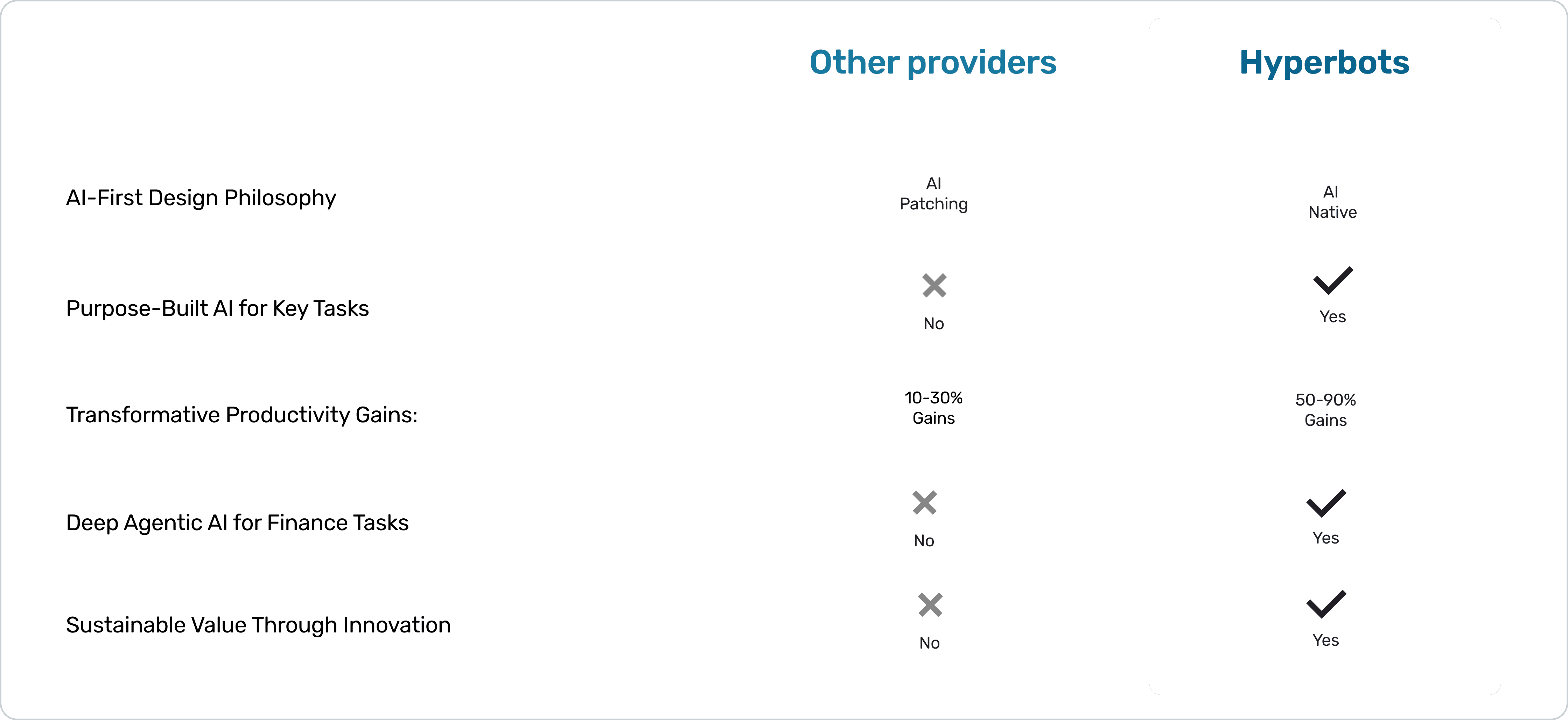
Hyperbots Co-pilots are designed with an AI-first approach, where AI models are developed specifically for each use case before building functionality around them.

Purpose-built AI for key tasks
AI elements are meticulously crafted to address specific business needs within finance workflows, ensuring precision and efficiency.

Transformative productivity gains
Unlike superficial AI layers or patchwork on traditional rules-based systems, Hyperbots Co-pilots achieve transformational productivity improvements of up to 90%, compared to 20-30% from competitors.

Deep agentic AI for finance tasks
Hyperbots leverages deep agentic AI to tackle complex tasks across finance processes, enabling Co-pilots to deliver results with minimal human touch.

Sustainable value through innovation
The AI-native approach positions Hyperbots to deliver long-term value, enabling continuous innovation and deeper automation for evolving customer needs.
Sustainable value through innovation
The AI-native approach positions Hyperbots to deliver long-term value, enabling continuous innovation and deeper automation for evolving customer needs.
Deep agentic AI for finance tasks
Hyperbots leverages deep agentic AI to tackle complex tasks across finance processes, enabling Co-pilots to deliver results with minimal human touch.
Transformative productivity gains
Unlike superficial AI layers or patchwork on traditional rules-based systems, Hyperbots Co-pilots achieve transformational productivity improvements of up to 90%, compared to 20-30% from competitors.
Purpose-built AI for key tasks
AI elements are meticulously crafted to address specific business needs within finance workflows, ensuring precision and efficiency.
AI-first design philosophy
Hyperbots Co-pilots are designed with an AI-first approach, where AI models are developed specifically for each use case before building functionality around them.
Comparison with competition
FAQs: AI Native
Why can traditional applications patched with AI capabilities not deliver the same outcomes as AI-native Co-pilots of Hyperbots?
Traditional applications with post-facto AI lack the deep integration required for advanced functionalities, often relying on basic rule-based approaches. Hyperbots’ AI-native Co-pilots leverage pre-trained models, contextual intelligence, and advanced algorithms to automate complex CFO processes end-to-end.
What is the difference in productivity gains between AI-native and non-native CFO applications?
AI-native applications, like Hyperbots, deliver productivity gains of up to 90% by achieving straight-through processing and automating decision-heavy tasks. Non-native applications often achieve only 20–30% productivity gains due to limited automation and dependency on manual interventions.
Which tasks cannot be automated deeply enough by non-native AI applications?
Non-native AI applications struggle with tasks requiring contextual understanding, such as GL coding recommendations, complex invoice matching, dynamic workflow handling, and multi-step accrual processes, often leading to frequent human interventions.
What is the approach difference in innovation and design thinking for AI-native vs. post-facto AI applications?
AI-native solutions focus on designing functionalities around AI capabilities from the ground up, prioritizing self-learning, adaptability, and decision-making. Post-facto AI applications retrofit existing workflows, resulting in fragmented and less effective automation.
Why can deep Agentic AI not be developed with non-native AI thinking?
Deep Agentic AI relies on models trained to mimic human-like reasoning, contextual adaptability, and collaboration between tasks. Non-native AI lacks the foundational architecture and design to achieve this level of integration and sophistication.
How can you demonstrate the difference between Hyperbots’ AI-native approach and traditional software for the CFO office?
Hyperbots can showcase real-world use cases, comparing straight-through processing rates, automation depth, and decision-making capabilities of AI-native Co-pilots against traditional patched AI software, highlighting transformative benefits and superior outcomes.
Why Hyperbots Agentic AI Platform?
Finance specific
Hyperbots Agentic AI platform specializes exclusively in finance and accounting intelligence, leveraging millions of data points from invoices, statements, contracts, and other financial documents. No other platform has such large pretrained models on F&A data.
Best-in-class accuracy
Hyperbots achieves 99.8% accuracy in converting unstructured data to structured fields through a multimodal MOE model integrating LLMs, VLMs, and layout models. With contextual validation and augmentations, the platform ensures 100% accuracy for deployed agents.
Synthesis of unstructured and strutured finance data
Hyperbots agents emulate finance professionals to autonomously perform F&A tasks by reading and writing data like COA, expenses, and vendor masters from core accounting systems and integrating it with unstructured data from financial documents such as invoices, POs, and contracts.
Pre-trained agents with state of the art models
Hyperbots' Agentic platform, pre-trained on millions of financial documents like invoices, bills, statements, and contracts, ensures seamless integration, high accuracy, and adaptability to any accounting content, form, layout, or size from day one.
Company specific inference time learning
Hyperbots' Agentic platform employs state-of-the-art Auto ML pipelines with techniques like reinforcement learning to enable inference-time learning for tasks such as GL recommendation and cash outflow forecasting, ensuring continuous improvement and adaptability.

Abbott

AbbVie

Amazon

Apple

Arrow Electronics

AT&T

AutoNation

Bank of America

Berkshire Hathaway (GEICO)

CBRE

Cigna Group

Cisco Systems

Citigroup

Costco

Dell Technologies

Dollar Tree

Duke Energy

Eli Lilly

ExxonMobil

FedEx

Goldman Sachs

Honeywell

HP / Hewlett Packard Enterprise

IBM

Jewel-Osco (Albertsons)

JLL

Johnson & Johnson

Liberty Mutual

Lowe's

Marathon Petroleum

Marriott International

Mastercard

McKesson

Medline

MetLife

PepsiCo

Pfizer

Phillips 66

Progressive

Southwest Airlines

Starbucks

Stryker

The Home Depot

Travelers

Tyson Foods

U.S. Bancorp

Valero Energy

Walmart

Warner Bros. Discovery

3M

Allstate

American Airlines

American Express

Applied Materials

Best Buy

Boeing

Capital One

Cardinal Health

Cencora

Charter Communications (Spectrum)

Chevron

Comcast

Cummins

CVS Health

Dollar General

Ford Motor Company

General Dynamics IT

Google (Alphabet)

Humana

International Paper

JPMorgan Chase

Kraft Heinz

Kroger

Marsh McLennan

McDonald's

Merck & Co.

Microsoft

Mondelez

Nationwide

PayPal

Prudential Financial

Publix

Southern Company

State Farm

Sysco

Target

The Hartford

The Walt Disney Company

Thermo Fisher Scientific

Uber

UNFI

United Airlines

UnitedHealth Group (incl. Optum)

UPS

US Foods

Verizon

Waste Management

Wells Fargo