Accuracy, Cost Efficiency, and Trust Are Defining Finance AI: Inside Insight Summits NYC TMT Finance Dinner
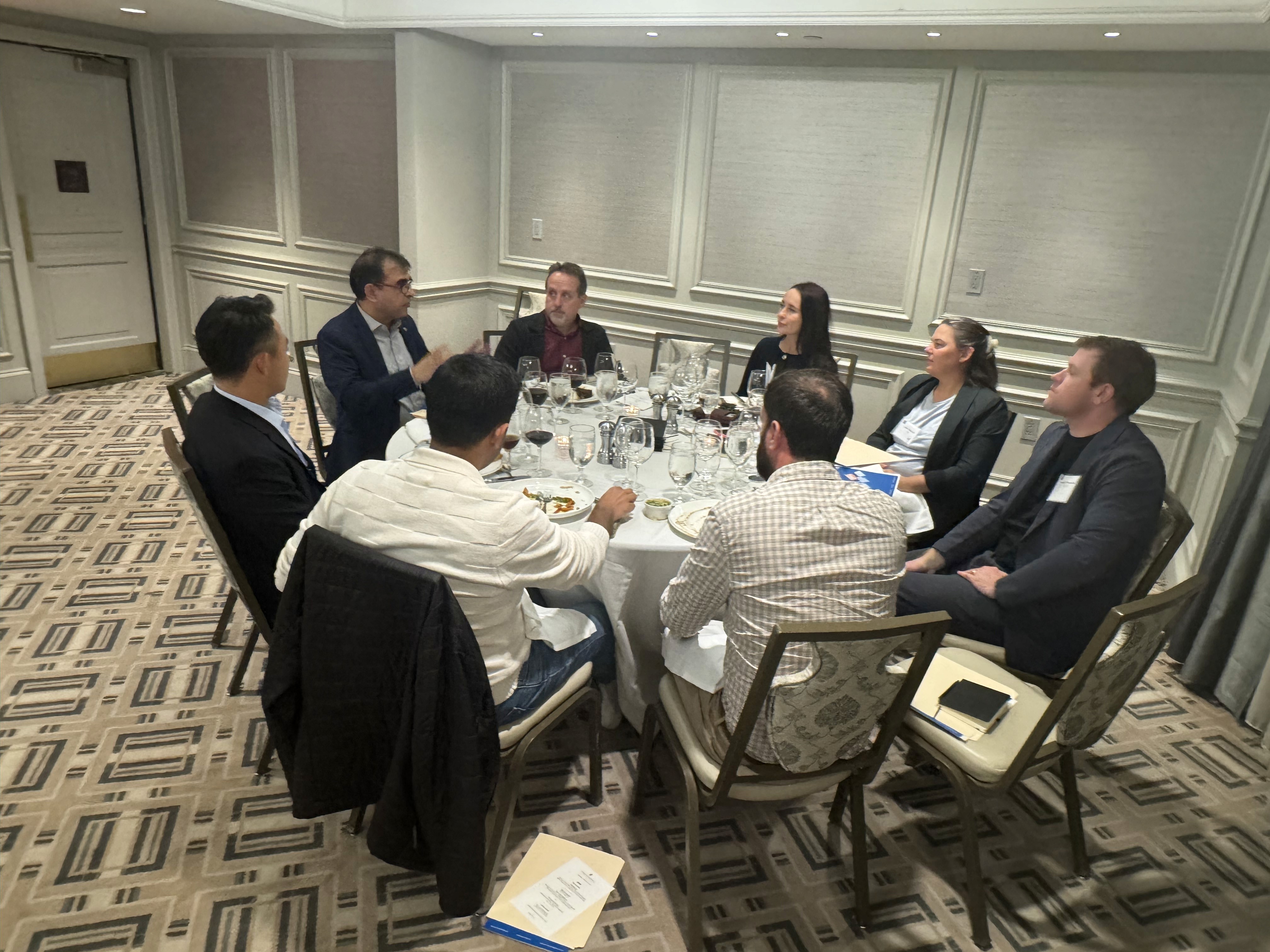
On October 8, 2026, Hyperbots sponsored the Insight Summits NYC TMT Finance Dinner at the InterContinental New York Barclay in New York City. The evening brought finance leaders together for conversations about the evolving role of artificial intelligence in Finance & Accounting, with a focus on where AI can deliver the greatest return on investment, how businesses can improve operational efficiency, and what it takes to build more autonomous finance functions.
Led by Hyperbots CEO and Co-founder Rajeev Pathak, the team connected with more than 25 attendees to exchange perspectives on the practical realities of enterprise AI adoption. Discussions covered the challenges of selecting the right AI models, persistent inefficiencies in procurement, the importance of security and reliability, and the growing need for AI solutions designed specifically for financial workflows.
A common thread ran through these conversations: as AI adoption matures, finance leaders are looking beyond what AI can demonstrate and asking what it can reliably accomplish in real business environments.
Why Finance AI Requires More Than a General-Purpose Model
One of the key discussion points raised by Stacey Zhou concerned model selection and cost efficiency in Finance & Accounting. With an expanding range of AI models available, CFOs face an important decision: how can they achieve the accuracy their financial workflows require without allowing AI operating costs to escalate?
For finance teams, this is not simply a question of choosing the most powerful available model. Different tasks have different requirements. Extracting information from invoices, interpreting accounting rules, identifying discrepancies, and supporting complex financial decisions may each demand different levels of reasoning and specialization.
Relying exclusively on large, general-purpose frontier models can introduce unnecessary costs when smaller, specialized models can handle particular tasks effectively. At the same time, selecting models based solely on price can create accuracy and reliability challenges, especially in workflows where errors have financial consequences.
During the discussion, Hyperbots shared its approach of combining seven specialized models, including Small Language Models (SLMs), with a Mixture of Experts architecture. The approach uses majority voting to help improve the consistency and accuracy of results, while specialization in Finance & Accounting helps manage inference costs.
Hyperbots also highlighted that its specialized finance models can operate at approximately one-tenth the token cost of frontier models from providers such as OpenAI and Anthropic.
The broader takeaway for CFOs is that effective AI adoption requires a balance between capability, cost, and task-specific performance. Rather than evaluating models on intelligence alone, finance leaders need to consider whether the underlying architecture can deliver the right results at a sustainable cost.
Addressing Procurement Bottlenecks with AI Agents

Another recurring theme throughout the evening was procurement inefficiency. Several CFOs highlighted ongoing challenges within their procurement functions, identifying the area as a strong candidate for AI-driven automation.
Procurement often involves multiple interconnected activities, including Purchase Requisitions (PRs), Purchase Order (PO) management, vendor coordination, invoice validation, approvals, and exception resolution. When these activities depend heavily on manual intervention or disconnected systems, processes can become slow, inconsistent, and difficult to scale.
These inefficiencies create an opportunity for AI agents to take on more than isolated tasks. Instead of simply summarizing procurement data or answering questions about transactions, purpose-built agents can be designed to execute defined workflow steps, validate information against business rules, identify exceptions, and support the movement of transactions through established processes.
This distinction between providing insights and executing work is important. While conversational AI can help finance professionals access information, agentic AI has the potential to address the operational steps that consume significant employee time.
For finance leaders, the objective is not merely to introduce AI into existing workflows. It is to identify where automation can reduce repetitive work, improve process consistency, and free teams to focus on analysis, decision-making, and higher-value activities.
The conversations at the dinner reinforced procurement as one of the areas where businesses can explore this transition from AI assistance to more autonomous execution.
Building Reliable AI: From Non-Deterministic Outputs to Consistent Workflows

Security and reliability were also important topics during the evening. As businesses move AI from experimentation into operational environments, CFOs must consider how to manage the variability of AI-generated outputs and ensure that automated processes behave consistently.
AI models can produce different outputs depending on the context, instructions, and information available. This non-deterministic behavior presents a particular challenge in Finance & Accounting, where transactions must comply with established policies, approval requirements, accounting rules, and audit expectations.
For enterprise finance teams, an intelligent response is not enough. AI systems must also be capable of producing outputs that can be validated against defined requirements before they are used to make decisions or execute transactions.
In response to questions about securing AI adoption, Hyperbots CEO and Co-founder Rajeev Pathak emphasized the importance of making AI's inherently non-deterministic outputs more predictable and reliable through layers of validation, augmentation, and business logic.
These safeguards help establish a more controlled operating environment. Validation can check outputs against expected formats and rules, augmentation can provide relevant context, and business logic can enforce requirements specific to a company's financial processes.
The goal is to make the consumption of AI agents feel as seamless and dependable as SaaS, particularly in process automation. Ideally, once workflows are configured with the appropriate controls, users should not need to engage in extensive conversational exchanges to ensure routine tasks are completed correctly.
This perspective highlights an important principle for enterprise AI: reliability must be designed into the system rather than treated as an afterthought. For CFOs, evaluating AI solutions for invoice processing, cash reconciliation, etc. therefore means examining not only their intelligence, but also the controls and safeguards that support dependable execution.
General-Purpose AI vs. Specialized Finance AI
Accuracy remained central to the conversations throughout the evening. Finance leaders need AI systems that understand the nuances of accounting and financial operations, rather than relying exclusively on general-purpose capabilities.
The distinction is significant because Finance & Accounting involves more than interpreting text or retrieving information. Financial workflows require an understanding of transaction structures, accounting classifications, reconciliation requirements, business rules, exceptions, and the relationships between different financial documents.
A general-purpose model may be capable of handling a broad range of tasks, but specialized finance workflows often require more targeted expertise and carefully designed controls.
Hyperbots illustrated this distinction by comparing the choice to using a qualified CPA for specialized accounting work rather than relying on a generalist. Both may possess valuable knowledge, but the requirements of a particular task determine which expertise is most appropriate.
The same principle applies to AI. Purpose-built finance AI like Hyperbots can be designed around the terminology, document structures, rules, and operational requirements encountered in financial processes. This domain specialization is especially relevant when AI is expected to support or automate workflows where inaccuracies can lead to reconciliation issues, incorrect classifications, compliance concerns, or additional manual work.
For CFOs evaluating AI solutions, the question is therefore not simply whether a model can understand a financial query. It is whether the system can consistently support the specific tasks, controls, and execution requirements of the finance function.
The discussion reinforced that domain expertise and accuracy must remain central to AI adoption, particularly as businesses begin automating more consequential financial activities.
Building the Next Generation of Intelligent Finance Operations

Taken together, the discussions at the Insight Summits NYC TMT Finance Dinner reflected a broader shift in how CFOs are evaluating AI.
Initial experimentation often focuses on what AI can generate, summarize, or explain. As adoption progresses, however, the priorities become more operational: whether the technology can execute tasks accurately, integrate into existing workflows, validate outputs, have a secure environment for enterprise use, and deliver measurable value without introducing unnecessary costs. Along with these assessments, evaluation of ROI gives more clarity on which processes give better quantified results.
These questions are particularly important in Finance & Accounting, where AI must operate within structured processes and established business controls.
The conversations highlighted several considerations for finance leaders planning their next steps:
Evaluate accuracy alongside cost: Assess AI models based on their performance in specific financial workflows, not just their general capabilities or pricing.
Prioritize high-impact automation opportunities: Identify repetitive and inefficient processes, including procurement, where AI agents can reduce manual intervention.
Build reliability into the architecture: Use validation, contextual information, and business rules to support predictable and controlled execution.
Choose solutions with finance-specific expertise: Consider whether AI systems understand the documents, accounting requirements, and exceptions relevant to the intended use case.
Measure operational outcomes: Evaluate AI in terms of process efficiency, execution quality, operating costs, and the ability to scale across financial operations.
Ultimately, moving toward autonomous finance requires more than introducing AI tools into existing systems. It calls for a deliberate approach to selecting models, designing workflows, establishing safeguards, and identifying where automation can produce meaningful business outcomes.
For CFOs, the opportunity lies in building finance operations where AI can do more than surface insights: it can help teams execute work more efficiently while maintaining the accuracy, control, and reliability that financial processes demand.
The Road Ahead for AI in Finance
The Insight Summits NYC TMT Finance Dinner provided a valuable opportunity to exchange perspectives on the practical challenges and opportunities shaping AI adoption across Finance & Accounting.
We thank Insight Summits and everyone who joined the evening for the thoughtful discussions and shared experiences. The conversations around model selection, procurement inefficiencies, AI reliability, and domain specialization reinforced the importance of approaching finance AI with a clear focus on execution and measurable value.
At Hyperbots, we believe the next phase of Finance & Accounting transformation will be shaped by AI that combines specialized domain knowledge with reliable execution, strong safeguards, and cost efficiency.
As finance leaders continue to move beyond experimentation, the priority is becoming clearer: build AI systems that do not just demonstrate intelligence, but deliver dependable results in the workflows that matter most.
Ready to explore what AI can do for your finance function? Discover how Hyperbots can help automate Finance & Accounting workflows and move your organization closer to autonomous finance.
Follow Hyperbots on LinkedIn to stay connected to the latest conversations, insights, and Finance Leaders Connect updates. And if you'd like to join the next discussion, visit our events page to explore upcoming finance events and reserve your spot.
We look forward to continuing the conversation and bringing it to more finance leaders across the country.