Insight Summits Tampa CFO Roundtable: AI Adoption in Finance.

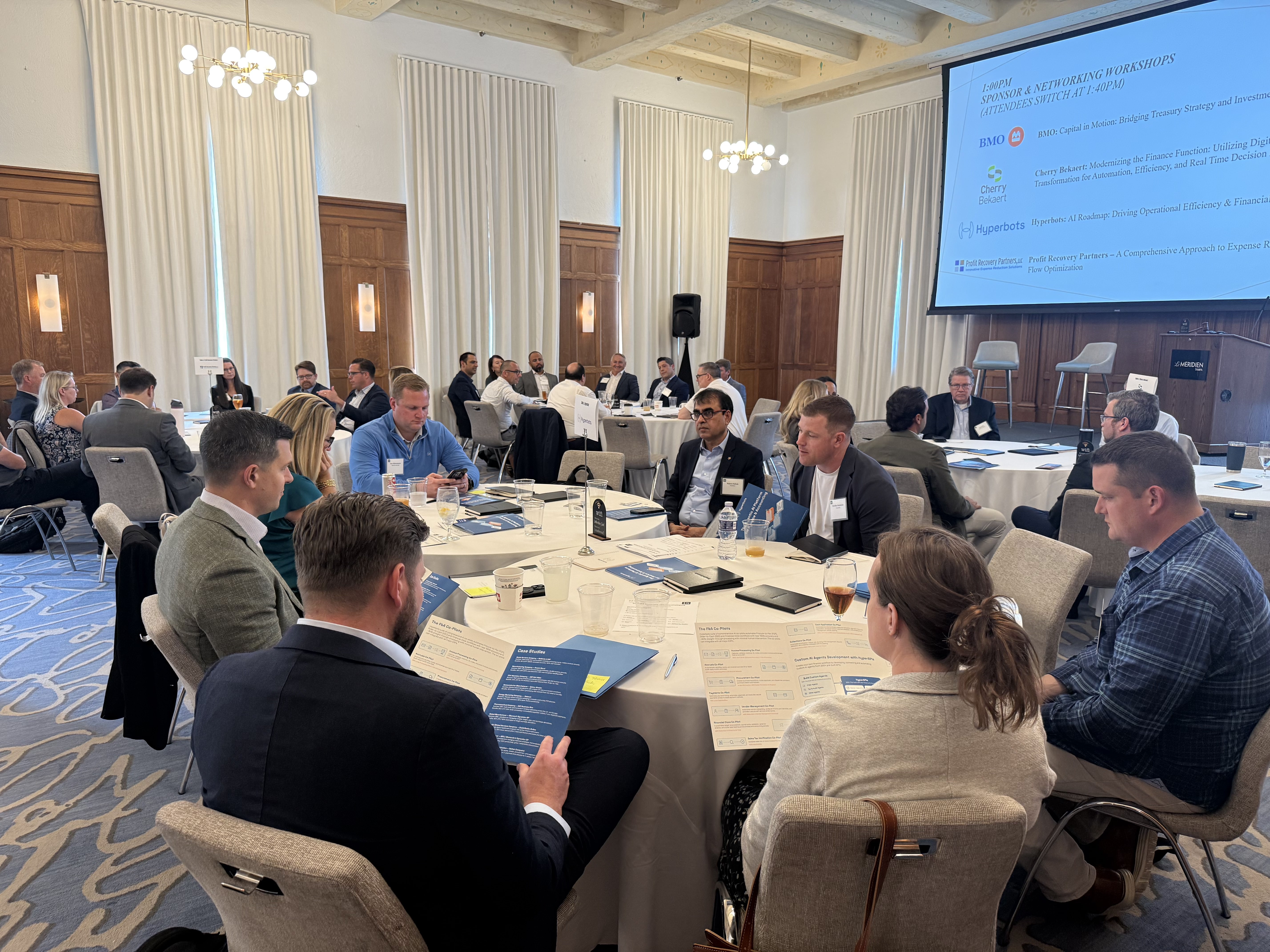
Tampa recently welcomed more than 40 CFOs and senior finance leaders for the Insight Summits Tampa CFO Roundtable, hosted by Hyperbots Inc. The room echoed with candid, practical conversation about what it actually takes to put AI to work in Finance - not the theory, but the day-to-day realities of implementation, governance, and ROI.
Rather than a series of formal presentations, the roundtable format encouraged an open exchange of experiences, challenges, and hard-won lessons from finance leaders navigating AI adoption across very different organizational structures.
Implementation Speed: Why "Long AI Timelines" Shouldn't Be the Default
One of the most recurring themes of the day was speed to value.
Many CFOs in the room shared a familiar frustration: AI projects often take far longer to go live than expected, quietly eroding the ROI Finance teams were promised at the outset. A tool that takes a year to implement has already lost much of its business case before it processes a single transaction.
The conversation turned to what the "modern" implementation actually looks like. Solutions like Hyperbots, built with pre-built connectors across finance systems, can typically go live in as little as 2 months for single-entity businesses and under 5 months for complex multi-entity structures, thanks to pre-trained AI co-pilots that don't need to be built from a blank slate. For finance leaders under pressure to show results quickly, timeline is no longer a reason to delay adoption, it's becoming a selection criterion in its own right.
Multi-Entity Complexity: One Platform, Many Realities
The discussion around multi-entity organizations proved to be one of the most engaging parts of the day.
One participant described a holding company structure with 36 business units, some running through shared services, others operating almost entirely independently. The core challenge wasn't a lack of will to modernize; it was reconciling different ERPs and finance workflows without forcing every business unit into an identical operating model.
This is where the group converged on a shared insight: enterprise AI adoption doesn't have to mean standardization for its own sake. Hyperbots' approach is to provide a single AI platform with built-in multi-entity support that spans these varied environments - giving leadership an enterprise-wide view, while AI agents handle complex finance workflows such as invoice processing, procurement, and payments at the business-unit level, respecting the nuances of how each unit actually operates.
Build vs. Buy: Why ROI Usually Settles the Debate
No CFO roundtable is complete without the build-vs-buy conversation, and Tampa was no exception.
One organization in the room had spent nearly a year attempting to build an AI solution internally, only to see the effort fail. The takeaway resonated across the table: Finance AI isn't just about having access to a capable model. It requires depth and width of system integrations, finance-specific domain expertise, exposure to millions of documents and data points, and the intelligence to navigate complex, cross-functional workflows.
Ultimately, the group agreed, the decision comes down to ROI and building a clear business case for AI-driven automation usually shows that buying a purpose-built platform delivers a faster, more reliable return than building from scratch. For CFOs weighing the decision, the CFO's toolkit for adopting AI is a useful place to start.
Ready-Made Agents: From "Can It Work?" to "How Do We Apply This?"
A natural follow-up question came up more than once in Tampa: if buying beats building, what exactly are CFOs buying? The first, and most familiar, answer is Hyperbots' Ready-Made Agents - a suite that covers both sides of the finance function out of the box.
On the payables side, the Invoice Processing, Accruals, Procurement, Payments, Vendor Management, and Sales Tax Verification agents automate the full source-to-settle workflow with near-100% accuracy and up to 80% straight-through processing. On the receivables side, the Cash Application and Collections agents handle remittance matching, dunning, and dispute detection with minimal manual intervention.
For the CFOs in the room managing multi-entity AP and AR, this is the layer that turns an 11-day invoice cycle into a same-day one, while still routing genuine exceptions to a human for a fast, informed decision rather than a manual dig through source documents. It's also what stops the conversation being "is this reliable" and turns it into "how would this fit into our environment" the same shift Hyperbots has seen play out at other CFO tables.
Custom Agents: Building Finance Workflows, Not Just Buying Point Solutions
For the kind of bespoke, BU-specific workflows that came up in the multi-entity conversation - different ERPs, shared services models, processes that don't fit a generic template - a single off-the-shelf tool isn't always the answer. That's where Hyperbots' Custom Agents come in, built using HyperAPIs: a library of 200+ pre-built Finance & Accounting APIs spanning master data, transactions, documents, workflows, analytics, and integrations.
Rather than treating AI as one fixed tool, HyperAPIs lets finance and IT teams compose their own FP&A agents, tax and audit agents, or industry-specific agents, then orchestrate and deploy them directly into existing ERP and enterprise systems - all on top of Hyperbots' proprietary finance-trained models, instead of building integrations and models from scratch. For finance leaders who already have unique processes and don't want to force-fit a generic tool, that flexibility was the appeal in Tampa, just as it has been in other rooms: it reframes the conversation from "which vendor do we buy" to "what can we build" without the year-long build cycles the roundtable's build-vs-buy discussion kept coming back to.
F&A Chatbot: A Private Workspace for the CFO's Own Questions
The third piece CFOs kept coming back to is Hyperbots' F&A Chatbot, delivered as a private, enterprise Platform-as-a-Service. It connects ERPs, spreadsheets, reports, and planning tools into a single natural-language workspace, so a CFO can ask something like "explain the budget swing by cost center" or "forecast cash flow for the next 13 weeks" and get a cited, board-ready answer in under a minute instead of a week of pulling reports.
That last part or the citations, is what tends to matter most to finance leaders: they don't just want an answer, they want to trace it back to the source. The same workspace handles monthly close commentary, board reporting, and driver-based revenue forecasting, cutting the time to query and consolidate data from hours to under a minute and reducing dependence on analytics and reporting teams by up to 80%.
Together, Ready-Made Agents, Custom Agents, and the F&A Chatbot are why "buy" keeps winning the debate in rooms like Tampa: the platform, the data pipeline, and the domain-specific models are already built and already learning from millions of transactions across customers.
A CFO's Perspective on Resilience and Long-Term Value
A special thanks goes to Grant Fitz, CFO at Sonny's Enterprises Inc., the conveyorized car wash equipment leader, who shared valuable perspectives on the CFO's evolving role in driving organizational resilience and long-term value creation. His remarks were well received by the room, giving attendees practical insights they could bring directly back to their own organizations.
Building Trust in AI: A Question From the Floor
Ankur Bhandari, CFO at Revinate and a close acquaintance of Hyperbots, raised one of the day's most important questions: How do Finance teams actually learn to trust AI?
The discussion that followed pointed to one clear answer: accuracy. Trust isn't built through promises; it's built through consistent, verifiable performance, the kind that comes from self-learning AI models that improve with every transaction. Accuracy is what ultimately drives the shift from finance teams relying on human-in-the-loop verification of every AI output to confidently allowing AI agents to execute autonomously.
A Forum Built for Honest Conversation
The Tampa CFO Roundtable reinforced what these gatherings are ultimately about: giving CFOs and finance leaders a genuine forum to share what's working, what isn't, and what it really takes to drive transformation in Finance. It's a conversation that has echoed across other recent Insight Summits and Hyperbots roundtables, from Houston and Phoenix to Philadelphia and Atlanta.
From implementation speed to multi-entity complexity to the build-vs-buy decision, the conversations in Tampa reflected where Finance leaders actually are in their AI journey - pragmatic, curious, and focused on measurable outcomes.
Want to be part of the next Insight Summits CFO Roundtable? Browse upcoming events and reserve your spot to connect with finance leaders exploring the future of AI in Finance and Accounting.


